Components of a Roller Chain Sprocket Assembly
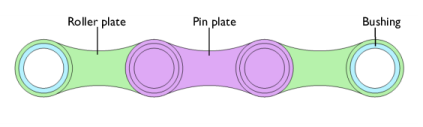
A roller chain sprocket assembly consists of two sprockets with a closed chain wrapped around them. The chain modeled here is of a roller type, and is constructed by joining a number of link plates together. A typical roller chain has two types of link plates, namely roller plates and pin plates. These plates are connected in such a way that the relative rotation between them is unrestricted. Often, elastic bushings are also present between the roller plates and the pin plates. The sketch in
Figure 2-23
shows the arrangement of the roller plates and the pin plates in a 2D roller chain unit.
Figure 2-23:
Components of a roller chain unit in 2D.
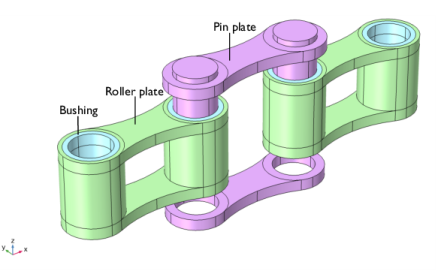
For a 3D roller chain, the constituent components are 3D link plates. Here, the roller plate is made of two hollow cylinders joined by two side plates. Similarly, the pin plate is a union of two solid cylinders joined by two side plates. A chain is formed by inserting the solid pin plates into the hollow cylindrical legs of the adjacent roller plates, producing a press-fit connection. This type of connection allows for relative rotation between the links, thereby helping the transmission of motion from one part of the system to another part. Optionally, elastic bushings between the roller and pin plates can be included. The sketch in
Figure 2-24
shows the arrangement of the roller plates and the pin plates in a 3D chain unit.
Figure 2-24:
Exploded view of a roller chain unit in 3D.
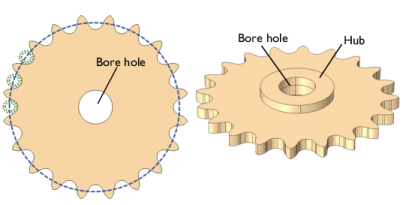
In 2D, a sprocket is a circular object with a number of teeth in which the rollers of the chain continuously engage and disengage while moving. A bore hole can optionally be created, which helps when mounting the system on external components, such as shafts. In 3D, you can also create a hub on both the top and bottom sides of the sprocket.
Figure 2-25:
Sprocket geometry in 2D and 3D.