Deriving the Radiative Heat Fluxes for Radiation Shields
Consider a surface wrapped with a radiative insulation layer. The definition of the heat fluxes involved in a radiation shield composed of a one or multiple layers relies on the plane parallel plate model according to Ref. 23. The net radiative heat flux from a plane plate of emissivity and temperature (ε1, T1) and a second parallel plate of emissivity and temperature (ε2, T2), reads:
Single-layer insulation
Figure 4-19 depicts the case of a single layer. This layer is assumed very thin, and therefore through-thickness temperature variation and tangential conduction can be neglected.
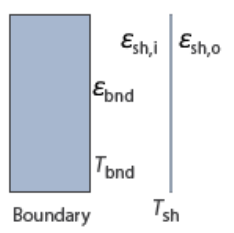
Figure 4-19: Configuration of a single-layer insulation radiation shield.
Following the plane parallel plate model, the net radiative heat flux from the boundary and the layer is thus defined as:
Multilayer insulation
The multilayer insulation consists of at least two layers, with N layers in between. The temperature variation across each layer remains negligible but the temperature can be different from one layer to another as represented on Figure 4-20 below.
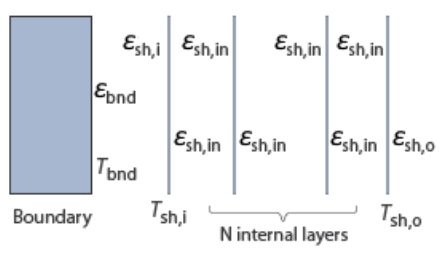
Figure 4-20: Configuration of a multilayer insulation radiation shield.
The net radiative heat flux from the boundary to the innermost side of the shield remains the same than with a single-layer radiation shield, but using the temperature of the innermost layer:
In addition, the net radiative heat flux from layer k to layer k+1 reads:
If the emissivity of all inner sides of the layers is the same and denoted εsh,in, the net radiative heat flux from the innermost to the outermost layer is then given by