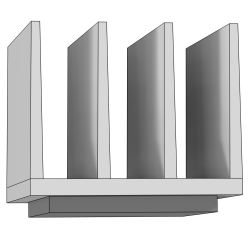
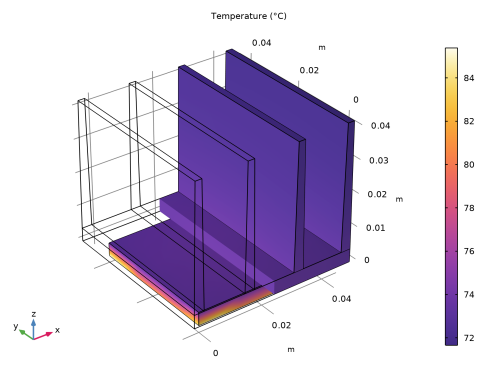
The heat sink represented in gray in Figure 10 is mounted inside a channel with a rectangular cross section. Such a setup is used to measure the cooling capacity of heat sinks. Air enters the channel at the inlet and exits the channel at the outlet. Thermal grease is used to improve the thermal contact between the base of the heat sink and the top surface of the electronic component. All other external faces are thermally insulated. The heat dissipated by the electronic component is equal to 10 W and is distributed through the chip volume.
The flow field is obtained by solving one momentum balance relation for each space coordinate (x,
y, and
z) and a mass balance equation. The inlet velocity is defined by a parabolic velocity profile for fully developed laminar flow. At the outlet, the normal stress is equal to the outlet pressure and the tangential stress is canceled. At all solid surfaces, the velocity is set to zero in all three spatial directions.
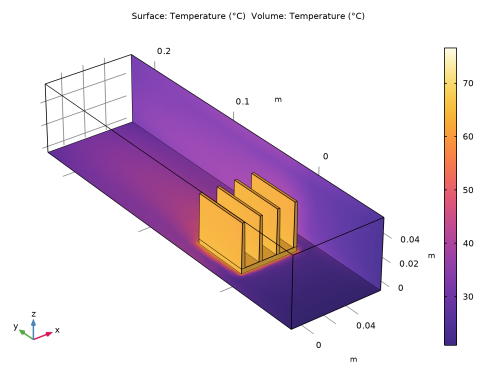
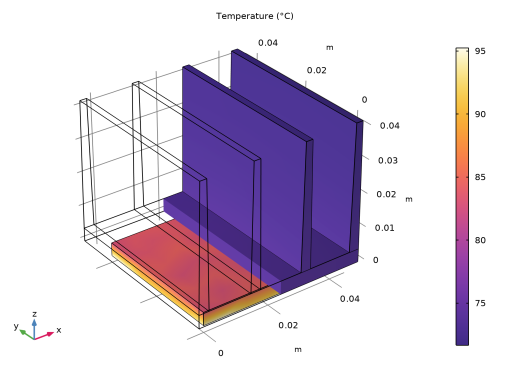
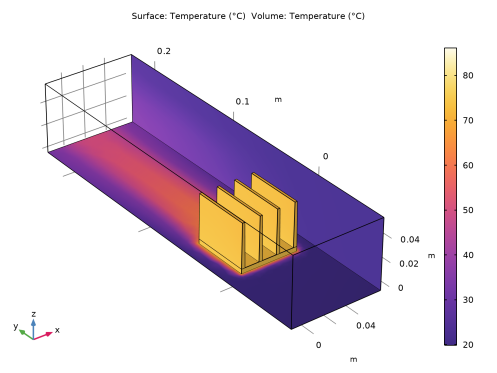
In Figure 14, the hot wake behind the heat sink is a sign of the convective cooling effects. The maximum temperature, reached in the electronic component, is about 85°C.
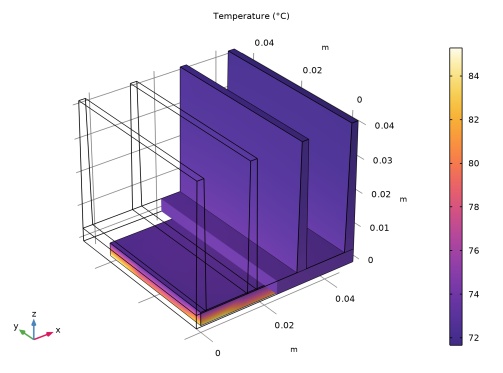
In the second step, the temperature and velocity fields are obtained when surface-to-surface radiation is included and the surface emissivities are large. Figure 15 shows that the maximum temperature, about 75°C, is decreased by about 10 °C when compared to the first case in
Figure 14. This confirms that radiative heat transfer is not negligible when the surface emissivity is close to 1.