Evaluating the Results
Compare the Polarization Curves
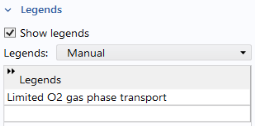
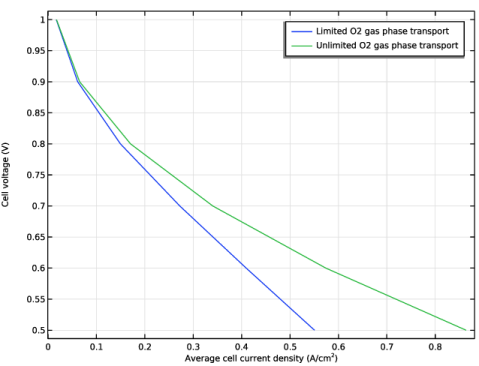
Modify the Polarization Curve as follows to compare the concentration independent and concentration dependent solutions.
1
2
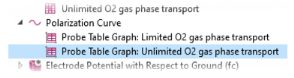
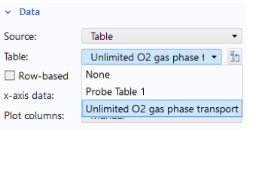
In the Settings window for Table Graph, type Probe Table Graph: Limited O2 gas phase transport in the Label text field.
3
4
5
6
In the Settings window for Table Graph, type Probe Table Graph: Unlimited O2 gas phase transport in the Label text field.
7
8
9
Mole Fraction, O2, Streamline
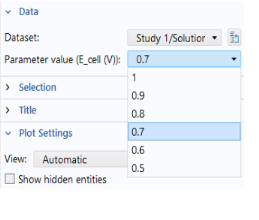
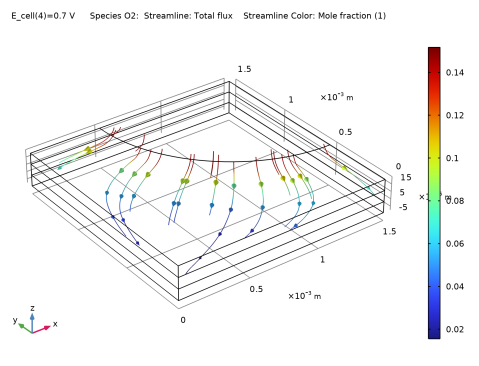
The mole fractions of the different species are plotted by default at the cell potential of 0.5 V. Modify the O2 plots as follows to plot at the cell potential of 0.7 V.
1
2
3
Note the direction of the arrows. Oxygen flows from the inlet hole into the porous cathode to react to form water.
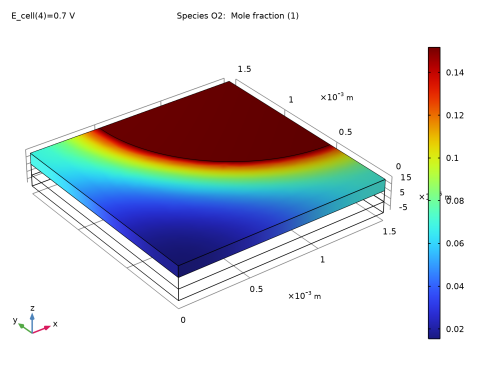
Mole Fraction, O2, Surface
1
2
3
The oxygen mole fraction gets low far away from the inlet hole.
Pressure
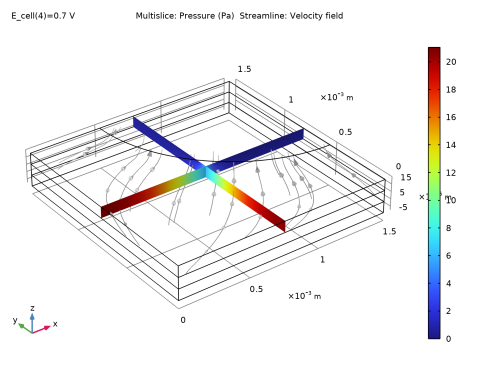
The Darcy pressure with velocity streamlines is also plotted by default at the cell potential of 0.5 V. Modify as follows to plot at the cell potential of 0.7 V.
1
2
3
The direction of the net velocity is toward the inlet hole, that is, opposite to the oxygen flux. This a result of the production of two water molecules per consumed oxygen molecule in the cathode.
Overpotential in Cathode
Finally, create some additional plots for the activation overpotential and local volumetric current density in the cathode gas diffusion electrode, and the current density at the anode gas diffusion electrode boundary.
1
2
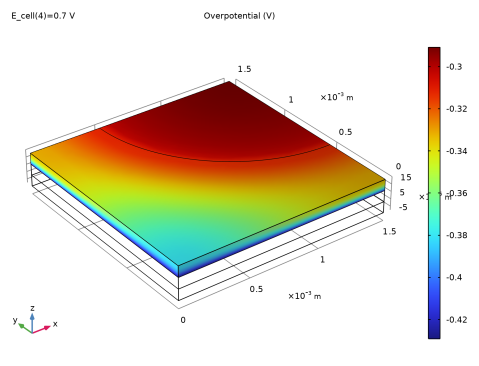
In the Settings window for 3D Plot Group, type Overpotential in Cathode in the Label text field.
3
Now add a Surface Plot as follows:
1
1
2
Generally, the highest overpotentials (in magnitude) are found in the region facing the Membrane domain. Since the overpotential is the driving force for the electrochemical reactions, this is the region were we can expect higher reaction rates.
Local Volumetric Current Density in Cathode
1
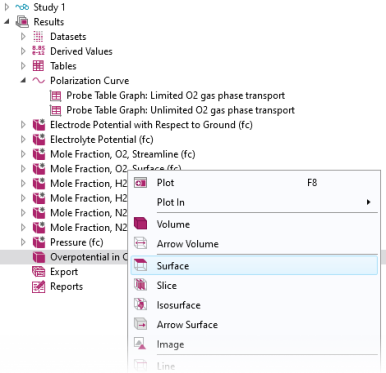
In the Home toolbar, click  Add Plot Group and choose 3D Plot Group.
2
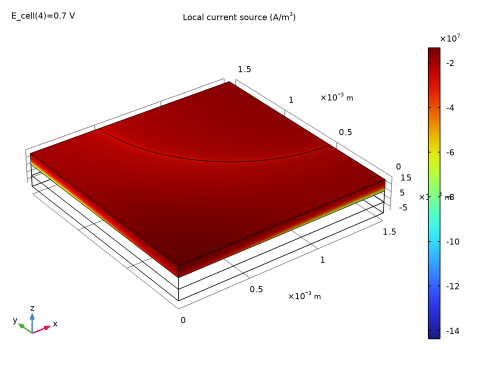
In the Settings window for 3D Plot Group, type Local Volumetric Current Density in Cathode in the Label text field.
3
Locate the Data section. From the Parameter value (E_cell (V)) list, choose 0.7.
Also here add a Surface plot as follows:
1
2
3
As for the overpotentials, the highest current density magnitudes are found close to the Membrane domain.
Current Density at Anode Boundary
1
2
3
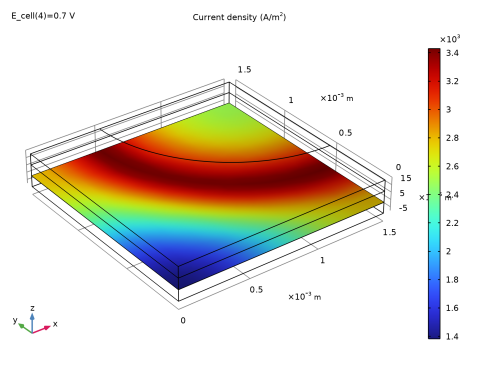
Use a boundary selection to plot the current density at the anode boundary only.
1
2
3
Add a Surface plot as follows:
1
2
3
The abs() is an operator which will return the absolute (positive) value of the argument.
4
5
6
The region of the highest current densities is located below the quarter circular edge of the inlet hole. In this area the combined effects of the ohmic and mass transfer losses in the gas diffusion electrode are at a minimum.
Power Losses
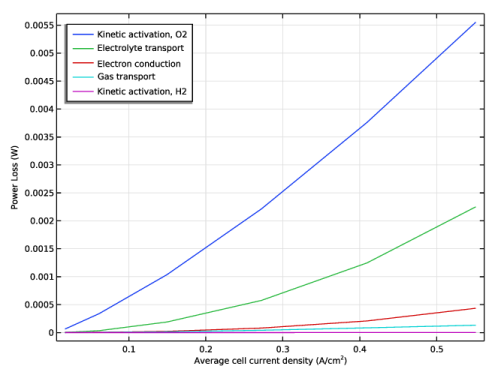
Finally, we will plot the different sources of power losses in the cell.
1
2
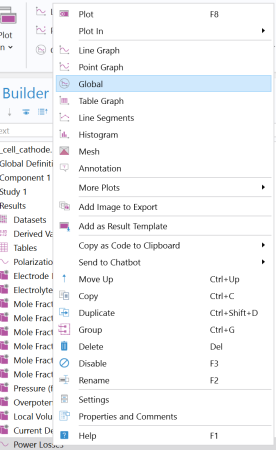
Create a plot of a Global variable as follows:
1
2
3
4
5
6
7
8
9
10
Power Losses
1
2
3
Select the x-axis label checkbox. In the associated text field, type Average cell current density (A/cm<sup>2</sup>).
4
5
6
Cell-Averaged Overpotentials
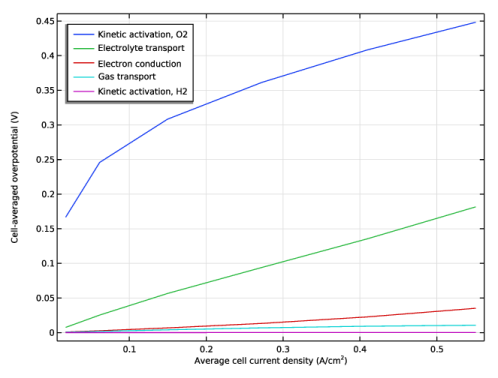
By dividing the integrated power losses of the cell by the cell current we can also compute corresponding overpotentials for the whole cell.
1
2
Modify the plot of a Global variable as follows:
1
2
3
Cell-Averaged Overpotentials
1
2
3
In y-axis label text field, type Cell-averaged overpotential (V).
4