Hydrogen Fuel Cell
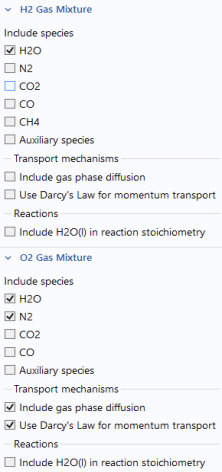
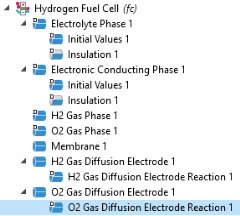
In the first part of the tutorial, a secondary (not concentration dependent) current distribution is modeled. Diffusion is hence disabled in the H2 and O2 gas phase mixtures. The default gas species are hydrogen and water on the anode side, and oxygen, nitrogen, and water on the cathode side.
1
2
3
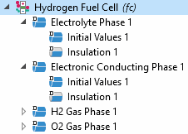
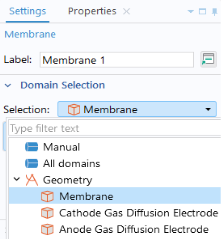
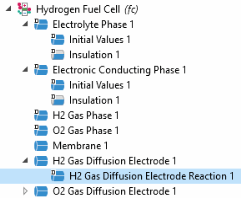
A number of domain nodes, defining the different phases present in the model were added by default. The active selection of these nodes are locked, but may be controlled by adding additional domain nodes (such as Membrane, and so on). Start by adding these additional nodes, and make the corresponding selections on the geometry.
Membrane
1
2
3
H2 Gas Diffusion Electrode
1
2
3
O2 Gas Diffusion Electrode
1
2
3
Electrolyte Phase
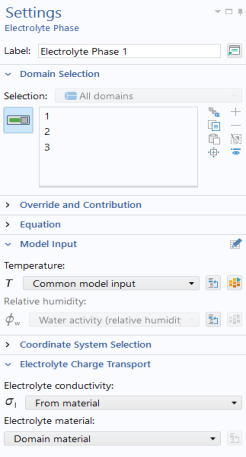
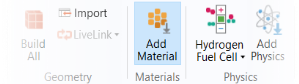
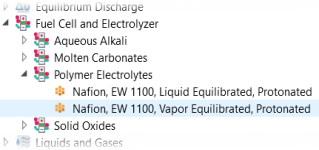
The Electrolyte Phase node should now be active on all three domains. Define the conductivity in the Electrolyte Phase node by using the Fuel Cell and Electrolyzer material library, which contains conductivity data for some common electrolytes.
Add Electrolyte Material
1
2
3
The polymer electrolyte conductivity depends on the temperature and the relative humidity. Specify the temperature globally in the Default Model Inputs node. The temperature defined in the Default Model Inputs node may be accessed by multiple physics nodes in the model (such as the Nernst and Butler-Volmer equations that will be set later).
Set Temperature in Default Model Inputs
1
2
3
4
Membrane
Also specify the relative humidity for the membrane electrolyte in the Membrane node.
1
2
3
In the aw text field, type RH.
Note that the water activity in the polymer of the gas diffusion electrodes (GDEs) is approximated to be in equilibrium with the adjacent gas phase in the pores, and is hence automatically set equal to the relative humidity in the GDEs.
H2 Gas Phase
The H2 Gas Phase node should be active in domain 1 only.
Set up the composition of the H2 gas phase mixture using the Humidified mixture option.
1
2
3
4
In the RHhum text field, type RH.
5
In the Thum text field, type T.
O2 Gas Phase
The O2 Gas Phase node should be active in domain 3 only.
Similarly, set up the initial composition of the O2 gas phase mixture using the Humidified air option.
1
2
3
4
In the RHhum text field, type RH.
5
In the Thum text field, type T.
H2 Gas Diffusion Electrode
Next set up the properties of the H2 Gas Diffusion Electrode node. Note that the electrolyte volume fraction is used to calculate the effective electrolyte conductivity in the porous gas diffusion electrode.
1
2
3
In the σs text field, type sigma_s.
4
H2 Gas Diffusion Electrode Reaction
The thermodynamics and kinetics of the hydrogen oxidation reaction are set in the child node that is added by default. Note that the reference equilibrium potential is calculated automatically when the default Built in option is used.
1
2
3
4
In the i0,ref(T) text field, type i0_ref_H2.
5
O2 Gas Diffusion Electrode
Set up the properties of the O2 Gas Diffusion Electrode node in the same way.
1
2
3
In the σs text field, type sigma_s.
O2 Gas Diffusion Electrode Reaction
The thermodynamics and kinetics of the oxygen reduction reaction are similarly set in the child node that is added by default. Note that the reference equilibrium potential is calculated automatically when the default Built in option is used.
1
2
3
In the i0,ref(T) text field, type i0_ref_O2.
4
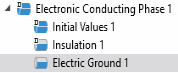
Ground Boundary Condition on the Anode Side
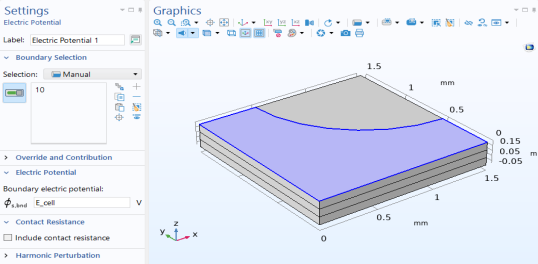
Finalize the secondary current distribution model by setting up the boundary conditions for the potentials in the electronic conducting phase.
1
2
3
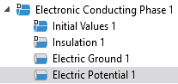
Potential Boundary Condition on the Cathode Side
1
2
3
4