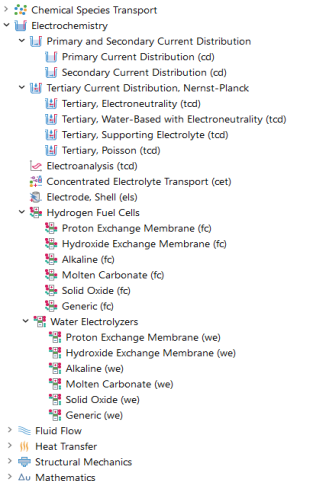
Figure 3 below shows the Fuel Cell & Electrolyzer Module interfaces, in the Electrochemistry branch, as displayed in the Model Wizard for a 3D model.
|
|
|
|
|
|
 Chemical Species Transport Chemical Species Transport |
|
|
|
|
|
|
|
|
|
|
|
|
|
|
|
|
|
|
|
|
|
|
|
|
|
|
|
|
|
|
|
|
|
|
|
|
|
|
|
|
|
|
|
|
|
|
|
|
|
|
|
|
|
|
|
|
 Reacting Flow Reacting Flow |
|
|
|
|
|
|
|
|
|
|
|
|
|
|
|
|
 Reacting Flow in Porous Media Reacting Flow in Porous Media |
|
|
|
|
|
|
|
|
|
|
|
|
|
|
|
|
 Nonisothermal Reacting Flow Nonisothermal Reacting Flow |
|
|
|
|
|
|
|
|
|
|
|
|
|
|
 Electrochemistry Electrochemistry
|
|
|
|
|
|
|
|
|
|
|
|
|
|
|
|
|
|
|
|
|
|
|
|
|
|
|
|
|
|
|
|
|
|
|
|
|
|
|
|
|
|
|
|
|
|
|
|
|
 Fluid Flow Fluid Flow |
|
|
 Multiphase Flow Multiphase Flow |
|
|
 Bubbly Flow Bubbly Flow |
|
|
|
|
|
|
|
|
|
 Mixture Model Mixture Model |
|
|
|
|
|
|
|
|
|
 Euler–Euler Model Euler–Euler Model |
|
|
|
|
|
|
|
|
|
 Phase Transport Mixture Model Phase Transport Mixture Model |
|
|
|
|
|
|
|
|
|
 Phase Transport Phase Transport |
|
|
|
|
|
|
|
|
|
|
|
|
|
|
|
|
|
|
|
|
|
|
|
 Porous Media and Subsurface Flow Porous Media and Subsurface Flow |
|
|
|
|
|
|
|
|
|
|
|
|
|
|
|
|
|
|
|
|
|
|
|
|
|
|
|
|
|
|
|
|
|
|
|
|
|
|
|
|
|
|
|
|
 Nonisothermal Flow Nonisothermal Flow |
|
|
|
|
|
|
|
 Heat Transfer Heat Transfer
|
|
|
|
|
|
|
|
Figure 4 shows an example 3D geometry of a cathode from a fuel cell with perforated current collectors. This geometry configuration can be used for self-breathing cathodes or in small experimental cells. Due to the perforation layout, a 3D model is needed in the study of the mass transport, current, and reaction distributions.
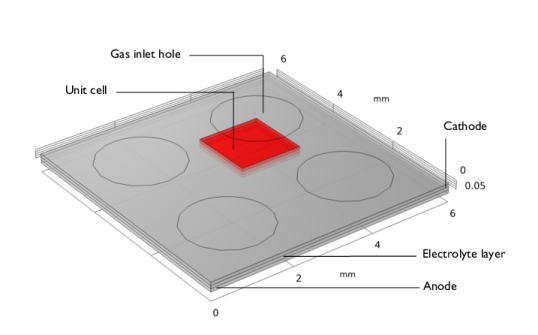
Figure 5 shows details for a unit cell, cut out from
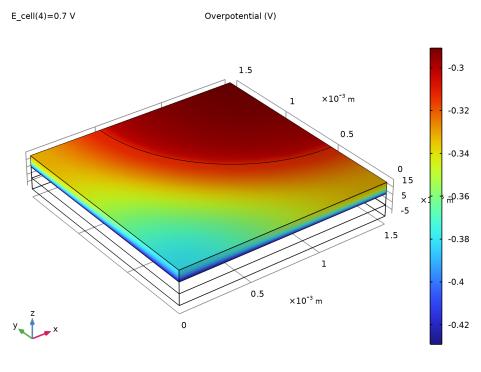
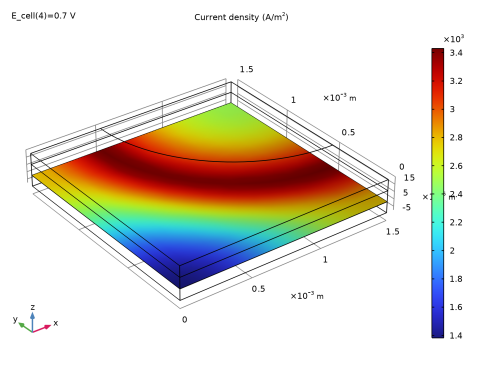
Figure 4. (In this case, the combination of a circular orifice and square unit cell eliminates the possibility to approximate the geometry with a rotationally symmetric model.) The circular hole in the collector acts as an inlet where the gas enters the modeling domain, and at this boundary the gas mixture composition and pressure is known. The upper and lower rectangular domains are the reaction-zone gas diffusion electrodes. They consist of a three-phase porous structure that contains the feed-gas mixture, an electronically conducting material covered with an electrocatalyst, and an ionically conducting electrolyte.
The Hydrogen Fuel Cell interface models the electronic and ionic current balances and solves for the potentials ϕs and
ϕl in the electrode and electrolyte phases, respectively. The anode side of the cell is grounded, whereas the current collector boundary at the cathode is set to a cell potential value.
The species (mass) transport is modeled by the Maxwell–Stefan equations for the mass fractions of oxygen, water, and nitrogen in the O2 gas phase. Mass transport is solved for in the cathode gas diffusion electrode domain only. Similarly, the pressure and the resulting velocity vector is solved for in the cathode gas diffusion electrode domain only using Darcy’s Law. (No mass transport effects are expected to occur at the hydrogen anode side). As boundary conditions, inlet molar fractions are set for the three gas species corresponding to a humidified air mixture at 90% relative humidity at atmospheric pressure.
where T denotes the temperature,
n the number of electrons participating in the electrode reaction, and
F Faraday’s constant.
where νi are the stoichiometric coefficients of the reacting species.
where pi is the partial pressure of the reacting species,
pref = 1 atm is the reference pressure and
ηref, the overpotential with respect to the reference state, is defined as
The local current density expression in the cathode is multiplied by a specific area of 109 m
2/m
3 to create a volumetric current source term in the electrode domain. Assuming ideal kinetics according to the mass action law,
αa,O2 + αc,O2 = n.
assuming αa,H2 + αc,H2 = n and where, since the anode boundary is grounded, the overpotential is defined as
In the first part of the model instruction below, a secondary (not concentration dependent) current distribution is modeled. In the second part, mass, and momentum transport is incorporated in the O2 gas phase mixture (cathode domain), using Maxwell–Stefan diffusion and Darcy’s Law, respectively. In both parts of the tutorial, the model is solved for a range of cell potential values (0.5 V to 1 V in steps of 0.1 V) by the use of an auxiliary sweep in the stationary solver.
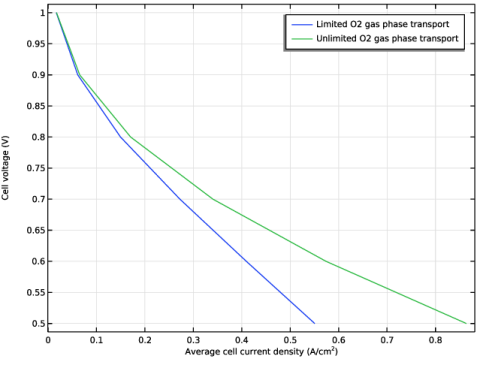
Figure 6 shows the polarization plot for the two scenarios investigated: limited and unlimited O
2 gas phase transport. It can be seen that higher average cell current densities are achieved for the unlimited O
2 gas phase transport scenario (that is, when no mass and momentum transport limitations are present).
Note that the plots and discussion in the rest of this section correspond to the limited O2 gas phase transport scenario, where diffusion and flow (in the cathode domain) have been considered, coupled to charge transport and the electrochemical reactions.
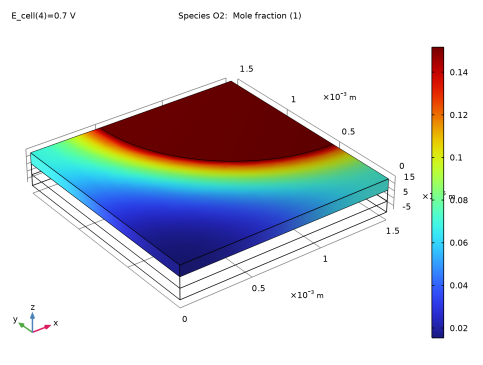
Figure 7 shows the oxygen mole fraction at cell voltage of 0.7 V. The figure shows that mole fraction variations are small along the thickness of the cathode, while they are substantially larger along the electrode’s width.
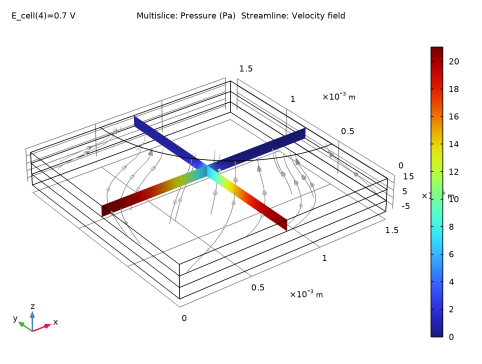
Figure 8 shows the pressure and gas velocity streamlines in the porous cathode at the same cell voltage. There is a significant velocity peak at the edge of the inlet orifice. This is caused by the contributions of the reactive layer underneath the current collector because in this region the convective flux dominates the mass transport. The gas flows from the interior of the cell toward the circular hole. The reason for this is the oxygen reduction reaction, with the creation of two water gas molecules, being transported out of the cell, per oxygen molecule entering the cell.
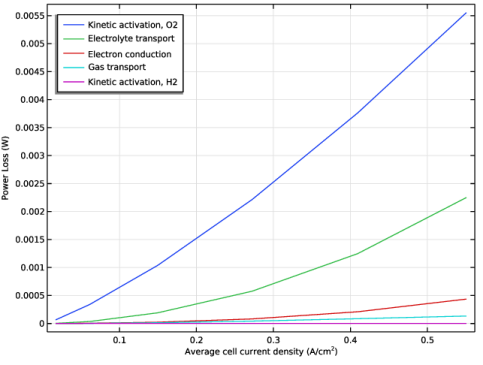
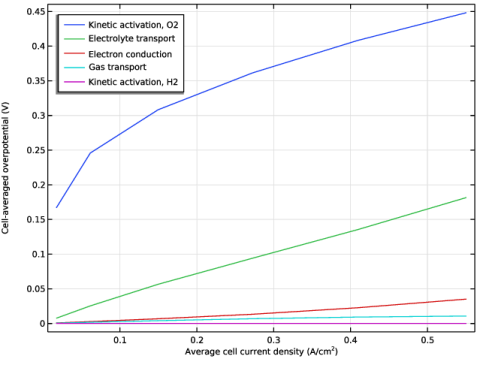
Figure 11 shows a plot of the cell-integrated power losses associated with the different processes in the cell. For this cell, the power losses due to kinetic activation of the oxygen reduction reaction dominate the losses, followed by the electrolyte transport losses.
By dividing the loss in power by the cell current, we can also compute the corresponding cell overpotentials, as shown in Figure 12. The oxygen reduction overpotential is highly nonlinear with respect to the cell current density. This stems from the Butler-Volmer kinetics deployed in the model. The electrolyte transport overpotential has a more linear behavior with respect to the cell current density.









 ) interfaces are based on the conservation of current, charge, chemical species, and energy. The Hydrogen Fuel Cell (
 ) interfaces and Water Electrolyzer (
 ) interfaces are tailor-made interfaces for these cell types. These interfaces combine electrolyte and electrode charge transport with charge transfer reactions, and, optionally, gas phase mass transport and momentum transport by Darcy’s law. Alternatively, the fluid flow in the gas channels and in the GDEs can be modeled by any of the Fluid Flow interfaces — such as Laminar Flow (
 ), Free and Porous Media Flow, Brinkman (
 ) and coupled to the hydrogen fuel cell or water electrolyzer interface.
 ), Secondary Current Distribution (
 ), and the Tertiary Current Distribution, Nernst–Planck (
 ) interfaces. The Primary Current Distribution interface neglects the variations in composition in the electrolyte and the activation losses for the charge transfer reactions. It should typically be used for electrolytes with fixed charge carriers or well-mixed electrolytes, and in the cases where the activation losses are substantially smaller than the conductivity losses. In the Secondary Current Distribution interface, the variations in composition in the electrolyte are also neglected, while the activation losses for the charge transfer reactions are taken into account. In the Tertiary Current Distribution, Nernst-Planck interface, also the contribution of diffusion to the transport of ions, and thus the bulk electrolyte contribution to the current in the electrolyte, is taken into account.
 ) is a generic interface for defining electrolyte transport. The electrolyte transport model is based on concentrated solution theory and can be applied to any type of electrochemical cell for an arbitrary number of electrolyte species. In contrast to the Tertiary Current Distribution, Nernst-Planck interfaces, the Concentrated Electrolyte Transport interface does not assume the presence of a neutral solvent, or a supporting electrolyte, of constant concentration. The interface may for instance be used to model the electrolyte transport of a molten carbonate fuel cell or electrolyzer cell.
 ), which all have nodes that couple the transport in the gas phase to the electrochemical reactions. The Chemical Species Transport interfaces are also coupled to the Fluid Flow interfaces (
 ) through the gas density, which is influenced by the gas composition. A convenient way of coupling chemical species transport to fluid flow is by using one of the Reacting Flow interfaces (Reacting Flow (
 ) or Reacting Flow in Porous Media (
 )), which contain predefined multiphysics couplings.
 ) handle the effects of Joule heating in the bulk electrolyte, in the pore electrolyte, and in the electrodes. They include the contribution to the thermal balance from the electrochemical reactions due to the activation overpotential and the net change of entropy.
 ) models electric current conduction in the tangential direction on a boundary. The physics interface is suitable to use for thin electrodes where the potential variation in the normal direction to the electrode is negligible. This assumption allows for the thin electrode domain to be replaced by a partial differential equation on the boundary. In this way the problem size can be reduced, and potential problems with mesh anisotropy in the thin layer can be avoided.
 denotes the standard equilibrium potential of the cell reaction, assuming all reactants reacting in the gas phase at atmospheric pressure.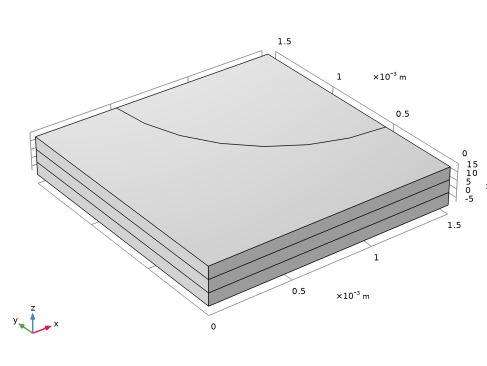
 .
. .
.