
Gas Discharges
Fluid Approximation
The Electric Discharge interface, like the Plasma interface, relies on the fluid approximation, which uses a single-moment description based on continuity equations. This approximation is generally valid when the product of gas pressure p and discharge gap length d exceeds 0.1 Torr·cm. If p·d falls below 0.1 Torr·cm, the fluid model becomes inaccurate, and particle models are required. For instance, with a discharge gap of 1 cm, the lowest pressure that can be accurately modeled is approximately 0.1 Torr (13.332 Pa). The fluid approximation remains valid for reduced electric fields up to 1500 Td (Ref. 1).
Local Field Approximation
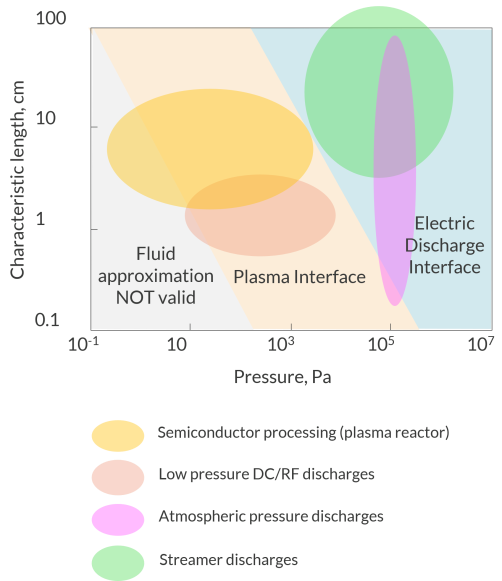
The behavior of electric discharges differs significantly under varying pressure-gap products p·d. For atmospheric pressure discharges, where p·d exceeds 200 Torr·cm, the Local Field Approximation (LFA) is commonly applied. The Electric Discharge interface is particularly focused on modeling such conditions, as shown in Figure 3-2.
Figure 3-2: General guidelines for choosing the Plasma interface or the Electric Discharge interface when modeling gas discharges.
Governing Equations
The Electric Discharge interface provides built-in charge transport models in gases. The default model consists of a group of transport equations for each modeled charge carrier (Ref. 1):
where
e, p, n denote electrons, positive ions, and negative ions
ni is the number density of the charge carrier (SI unit: 1/m3)
E is the electric field (SI unit: V/m)
zi denotes the carrier charge (SI unit: 1)
μi denotes the carrier mobility (SI unit: m2/(V·s))
wi is the drift velocity in the electric field (SI unit: m/s)
Di is the diffusion coefficient (SI unit: m2/s)
Ri is the reaction rate (SI unit: 1/(m3·s))
α is the ionization coefficient (SI unit: 1/m)
η is the attachment coefficient (SI unit: 1/m)
βep is the electron–ion recombination coefficient (SI unit: m3/s)
βpn is the ion–ion recombination coefficient (SI unit: m3/s)
The above transport equations are fully coupled with Poisson’s equation through the electric field and the space charge:
where e is the elementary charge.
Photoionization
To model positive gas discharges, it is necessary to compute the photoionization rate. Numerical simulations typically employ the radiative transfer model (Ref. 2) for this purpose:
where
Sphjdenotes jth photoionization rate component (SI unit: 1/(m3·s))
pp is the partial pressure (default value: 150 Torr)
p is the gas pressure (default value: 760 Torr)
pq is the quenching pressure (default value: 30 Torr)
ξνui is the photoionization parameter (default value: 0.06)
Aj and λj are fitting parameter
Iph is the effective ionization intensity (SI unit: 1/(m3·s))
Sion is the impact ionization rate (SI unit: 1/(m3·s))