 AC/DC AC/DC |
|||||
 |
stationary; frequency domain; time dependent; frequency domain; eigenfrequency
|
||||
 |
stationary; time dependent; stationary source sweep; eigenfrequency; frequency domain; small signal analysis, frequency domain
|
||||
 |
|||||
 Chemical Species Transport Chemical Species Transport |
|||||
 |
|||||
 |
|||||
 Electric Discharge Electric Discharge |
|||||
 |
|||||
 |
|||||
 |
|||||
 Plasma Plasma |
|||||
 |
|||||
 |
|||||
 Radio Frequency Radio Frequency |
|||||
 |
|||||
 |
|||||
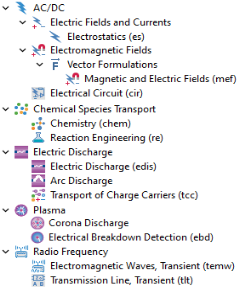
 ), found under the AC/DC branch in the Model Wizard, solves for the electric potential given the charge distribution in the domain and the voltages applied to boundaries. It is used to model electrostatic devices under static or quasistatic conditions, that is, at frequencies sufficiently low that wave propagation effects can be neglected. The Electrostatic interface is often used together with the Transport of Charge Carriers interface. Note that the Electric Discharge interface has the built-in electrostatics solver and transport equation solver.
 ), found under the AC/DC branch in the Model Wizard, is used to model magnetostatics and magnetodynamics. It solves Ampère’s law for the magnetic vector potential together with a current conservation equation for the electric potential. This interface is often used to solve electromagnetics in electric arc discharges that are formulated in magnetohydrodynamics equations.
 ), found under the AC/DC branch in the Model Wizard, has the equations to model electrical circuits with or without connections to a distributed fields model. The interface solves for the voltages, currents, and charges associated with the circuit elements. Circuit models can contain passive elements like resistors, capacitors, and inductors as well as active elements such as diodes and transistors. Circuits can be imported from an existing SPICE net list. The interface can be connected to the Electric Discharge interface to model discharge phenomenon triggered in a circuit.
 ) includes all of the tools required to simulate chemical reaction kinetics in well-defined environments. It sets up simulations of reversible, equilibrium, and irreversible reactions in volumes or on surfaces. You can study the evolution of species concentrations and temperature in controlled environments described by batch, continuous stirred-tank, semibatch, and plug flow reactors. Using the Parameter Estimation Study, multiple objectives may be optimized, and with the Optimization Module, additional methods become available.
 ) provides libraries of chemical reactions for use by other physics interfaces. It also provides kinetic expressions for reaction rates, reaction heat sources, and species transport properties to other interfaces. This interface is always created when a Reaction Engineering model is exported to a space-dependent model. As such, it serves as a reaction kinetics and material property provider to the space-dependent transport interfaces, such as Transport of Diluted Species.
 ) is used to simulate electric discharges and predict electrical breakdown in gas, liquid, and solid dielectrics. It contains built-in charge transport models that solve the drift-diffusion equations of electrons, holes, positive and negative ions fully coupled with Poisson’s equation. In addition, it can also model the surface charge accumulation and relaxation effect at dielectric interfaces. Typical modeling applications are streamer discharges, corona discharges, electrostatic discharges, and dielectric barriers discharges. The effect of a background magnetic field and/or a flow field can be easily considered by coupling to another physics interface.
 ) is used to study electric arc discharges (fully ionized) in a magnetohydrodynamics (MHD) framework. This multiphysics interface adds three single physics interfaces: Magnetic and Electric Fields, Heat Transfer in Fluids, and Laminar Flow, together with several multiphysics coupling features. The multiphysics couplings add the MHD coupling between the Magnetic and Electric Fields and the Laminar Flow interfaces. The multiphysics couplings also add heating and cooling of the equilibrium plasma by enthalpy transport, Joule heating and radiation loss.
 ) is used to solve the number density of one or multiple charge carriers. The charge carriers can be charged species such as electrons, ions, and neutral species like molecules and their excited states. Transport and reactions of charge carriers can be handled with this interface. The driving forces for transport can be drift when coupled to an electromagnetic field, convection when coupled to a flow field, and diffusion.
 ) solves a time-domain wave equation for the electric field. The sources can be in the form of point dipoles, line currents, or incident fields on boundaries or domains. It is used primarily to model electromagnetic wave propagation in different media and structures when a time-domain solution is required — for example, nonsinusoidal waveforms or nonlinear media. Typical applications involve the propagation of electromagnetic pulses and the generation of harmonics in nonlinear optical media.
 ) is used to study propagation of waves in time domain along one-dimensional transmission lines. The physics interface solves the time-domain transmission line equation for the electric potential.