The process is inherently time-dependent because the cathode boundary moves as the deposition process takes place. The model is defined by the material balances for the involved ions — copper, Cu2+, and sulfate, SO
42- — and the electroneutrality condition. This gives three unknowns and three model equations. The dependent variables are the copper ion, sulfate ion, and ionic potentials. Additional variables keep track of the deformation of the mesh.
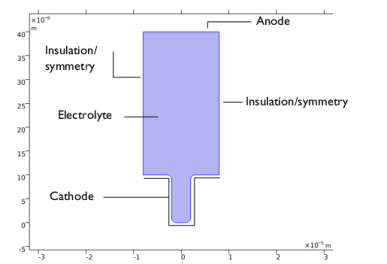
The model geometry is shown in Figure 5. The upper horizontal boundary represents the anode, while the cathode is placed at the bottom. The vertical walls correspond to the pattern on the master electrode and are assumed to be insulating.
where Ji denotes the transport vector (mol/(m
2·s)),
ci the concentration in the electrolyte (mol/m
3),
zi the charge for the ionic species,
ui the mobility of the charged species (m
2/(s·J·mole)),
F Faraday’s constant (A·s/mole), and

the potential in the electrolyte (V). The material balances are expressed through
one for each species, that is i = 1, 2. The electroneutrality condition is given by the following expression:
where the first step is rate determining step, RDS, and the second step is assumed to be at equilibrium (Ref. 1). This gives the following relation for the local current density as a function of potential and copper concentration:
where η denotes the overpotential defined as
where n denotes the normal vector to the boundary. The condition at the anode is
You set up Equation 11 through
Equation 21 using the Tertiary Current Distribution, Nernst–Planck interface. The Deformed Geometry interface keeps track of the deformation of the mesh.
Figure 6 shows the concentration distribution of copper ions, the isopotential lines, the current density lines, and the displacement of the cathode and anode surfaces after 14 seconds of operation. The figure shows that the mouth of the cavity is narrower due to the nonuniform thickness of the deposition. This effect can be detrimental to the quality of the deposition because a trapped electrolyte can later cause corrosion of components in the circuit board. In addition, the simulation shows substantial variations in copper ion concentration in the cell. Such variations eventually cause free convection in the cell. The model is symmetric along a vertical line in the middle of the cell. A nonsymmetric result is a sign of poor mesh resolution.
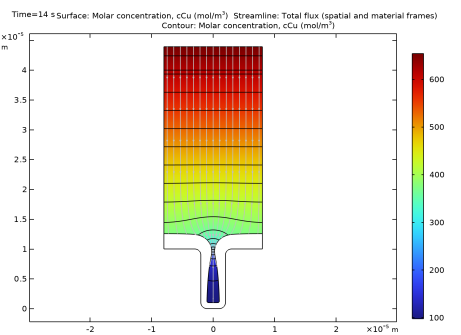
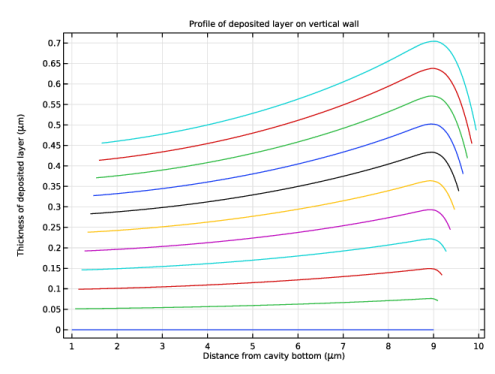
Figure 7 shows the thickness of the deposition along one of the vertical cathodic surfaces. The lines reveal the development of the nonuniform deposition due to nonuniform current density distribution. This effect is accentuated by the depletion of copper ions along the depth of the cavity.











 denotes the electronic potential of the respective electrode. This gives the following condition for the cathode:
 for the copper ions in the electrolyte, and
  for the copper atoms in the electrodes.