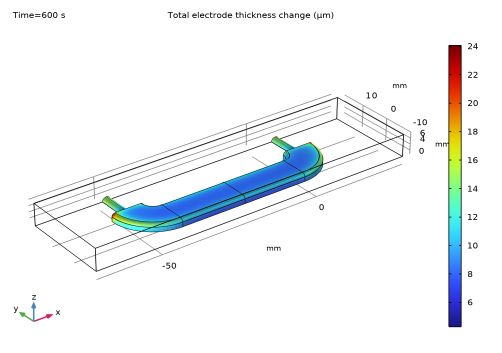
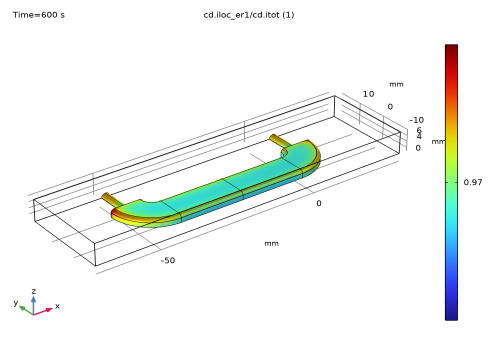
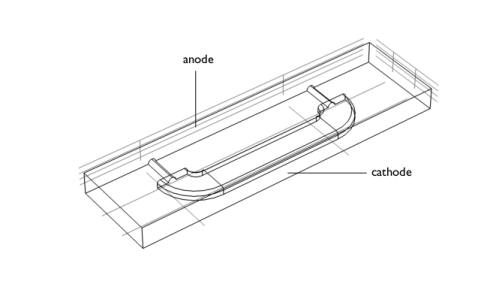
The model geometry is shown in Figure 4. The anode is a planar dissolving anode. The cathode represents a furniture fitting that is to be decorated by metal plating.
The overpotential, η m, for an electrode reaction of index
m, is defined according to the following equation:
where ϕs,0 denotes the electric potential of the metal,
ϕl denotes the potential in the electrolyte, and
Eeq,m denotes the difference between the metal and electrolyte potentials at the electrode surface measured at equilibrium using a common reference potential. The electric potential of one of the electrodes may be bootstrapped, so that all other potentials are measured with this reference (this bootstrap can actually be achieved by fixing the potential at any point in the cell). In this case, the electric potential of the metal is selected at the cathode as a bootstrap by setting this potential to 0 V. This implies that the electric potential of the metal at the anode is equal to the cell voltage. The potential of the electrolyte floats and adapts to satisfy the balance of current, so that an equal amount of current that leaves at the cathode also enters at the anode. This then determines the overpotential at the anode and the cathode.
where il (A/m
2) is the electrolyte current density vector and
σl (S/m) is the electrolyte conductivity, which is assumed to be a constant.
where n is the normal vector, pointing out of the domain.
where M is the mean molar mass (59 g/mol) and
ρ is the density (8900 kg/m
3) of the nickel atoms and
n is number of participating electrons. It should be noted that the local current density is positive at the anode surface and it is negative at the cathode surfaces.