Introduction
Modeling and simulations are cost-effective ways to understand, optimize, and control electrodeposition processes.
The Electrodeposition Module is intended to investigate the influence of different parameters in an electrodeposition cell or on the thickness and composition of deposited layers. Important parameters that can be studied with the module include the following:
•
Cell geometry
•
Electrolyte composition and mixing
•
Electrode kinetics
•
Operating potential and average current density
•
Temperature
A typical simulation yields the current distribution in the electrodeposition cell and at the surface of the electrodes. Faraday’s law and the properties of the deposited material give them the thickness and composition of the deposited layer. This module is able to model cells both when the deposited thickness is negligible in comparison to the interelectrode gap and where the growth and dissolution of the electrodes have to be taken into account using moving boundaries.
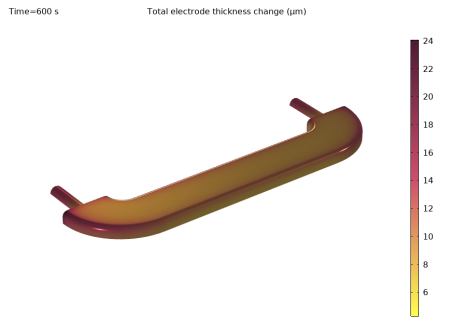
Figure 1:
Thickness of the decorative deposited layer in a furniture fitting modeled using simulations based on secondary current distribution.
The targeted applications for the Electrodeposition Module include the following:
•
Copper deposition for electronics and electrical applications
•
Metal deposition for protection of parts, such as corrosion protection and protection against wear
•
Decoration of metals and plastic parts
•
Electroforming of parts with thin and complex structure
•
Metal electrowinning
The next section introduces you to the available physics interfaces for this module and provides a brief overview of their use. It also includes a table listing the physics interfaces by space dimension and preset study type.
The rest of the introduction includes two tutorials. The first is a secondary current distribution model (secondary here means that we are including ohmic drops and activation overpotentials, but neglecting mass transport effects) where the thickness of the deposited layer can be neglected in the simulation and it therefore uses a fixed geometry. Go to the
Tutorial — Decorative Plating
to get started with this example.
The second model is a full tertiary current density distribution model (tertiary here means that we include ohmic drops, activation potentials and mass transport) that also accounts for the changes in the shapes of the cathode and anode surfaces using moving boundaries. Go to the
Tutorial — Copper Deposition in a Trench
to start working with this model.