 Chemical Species Transport Chemical Species Transport |
|||||
 |
|||||
 |
|||||
 |
|||||
 |
|||||
 |
|||||
 |
|||||
 Reacting Flow Reacting Flow |
|||||
 |
|||||
 Electrochemistry Electrochemistry |
|||||
  |
|||||
 |
|||||
 |
|||||
 |
|||||
 |
|||||
 |
|||||
 Fluid Flow Fluid Flow |
|||||
 Porous Media and Subsurface Flow Porous Media and Subsurface Flow |
|||||
 |
|||||
 |
|||||
 |
|||||
 |
|||||
 Nonisothermal Flow Nonisothermal Flow |
|||||
 |
|||||
 Heat Transfer Heat Transfer |
|||||
 |
|||||
 ), Secondary Current Distribution (
 ), and Tertiary Current Distribution, Nernst Planck (
 ) interfaces.
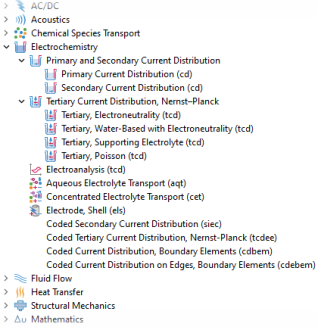
 ) interface accounts for the transport of species through diffusion, migration, and convection and is therefore able to describe the effects of variations in composition on the electrochemical processes. Four different alternatives to handle electrolyte charge conservation (Electroneutrality, Water-Based with Electroneutrality, Supporting Electrolyte, and Poisson) are available. The kinetics expressions for the electrochemical reactions account for both activation and concentration overpotential.
 ) interface computes the potential and species concentration fields in a dilute aqueous electrolyte. The interface targets modeling of aqueous electrolytes featuring weak acids, weak bases, ampholytes, and generic complex species. This includes, but is not limited to, electrochemical systems and phenomena containing multiple homogeneous reactions coupled to electrode kinetics. The transport is defined by the Nernst-Planck equations in combination with electroneutrality and water autoprotolysis.
 ) is a generic interface for defining electrolyte transport. The electrolyte transport model is based on concentrated solution theory and can be applied to any type of electrochemical cell for an arbitrary number of electrolyte species. In contrast to the Tertiary Current Distribution, Nernst-Planck interfaces, the Concentrated Electrolyte Transport interface does not assume the presence of a neutral solvent, or a supporting electrolyte, of constant concentration.
 ) models mass transport of diluted species in electrolytes using the diffusion-convection equation, solving for electroactive species concentrations. The physics interface is applicable for electrolyte solutions containing a large quantity of excess (supporting) electrolyte. Ohmic losses in the electrolyte are assumed to be negligible. The physics interface includes tailor-made functionality for setting up cyclic voltammetry problems.
 ) is available under the Chemical Species Transport branch. This physics interface can be used to model transport of species due to diffusion, migration, and convection.
 ) interface option combines an Electrostatic interface (
 ) with a Transport of Diluted Species interface (
 ). This combination can be used for investigation of charge and ion distributions within the electrochemical double layer where charge neutrality cannot be assumed. A requisite here is that the double layer, which typically is in the range of tens nanometers, is fully resolved in the mesh. The equations solved for are identical to the Electrochemistry>Tertiary Current Distribution, Poisson interface.
 ) is also available and describes species transport between the fluid, solid, and gas phases in saturated and variably saturated porous media. The interface can for instance be used to model mass transport of noncharged particles within porous electrodes filled with aqueous electrolyte.
 ) interface can be used to investigate the transport of weak acids, bases, and ampholytes in aqueous solvents. The physics interface is typically used to model various electrophoresis modes, such as zone electrophoresis, isotachophoresis, isoelectric focusing, and moving boundary electrophoresis, but is applicable to any aqueous system involving multiple acid-base equilibria.
 ) can be used model reactions and translateral transport of surface (adsorbed) species.
 ) can be used to define systems of reacting species, electrode reactions and ordinary chemical reactions. As such, it serves as a reaction kinetics and material property provider to the space dependent transport interfaces, such as the Tertiary Current Distribution or Transport of Diluted Species interfaces.
 ) can be combined with the Electrochemistry Module interfaces to model free and forced convection in electrochemical cells.
 ) is used to model fluid movement through interstices in a porous medium where a homogenization of the porous and fluid media into a single medium is done. Together with the continuity equation and equation of state for the pore fluid (or gas) this physics interface can be used to model low velocity flows, for which the pressure gradient is the major driving force. The penetration of electrolyte through a porous electrode is a classic example for the use of Darcy’s Law in electrochemical engineering.
 ) is used to model compressible flow at speeds of less than Mach 0.3, but control over the density and any of the mass balances that are deployed must be maintained to help with this.
 ) and the Free and Porous Media Flow, Darcy interface (
 ) are useful for equipment that contain domains where free flow is connected to porous media, such as concrete structures immersed in water.
  ) have in-built formulations for the contribution of Joule heating, and other electrochemical heat sources, to the thermal balance of electrochemical cells.
 ), Heat Transfer in Solids (
 ), and Heat Transfer in Porous Media (
 ), and account for conductive and convective heat transfer. These features interact seamlessly and can be used in combination in a single model.