Introduction
The Electrochemistry Module is intended for the modeling and simulation of generic electrochemical cells.
The module defines components in 1D, 2D, and 3D geometries that describe the electrochemical reactions, and other surface reactions, at the interface between a metal electrode and an electrolyte, as well as the transport of ions and neutral species in the electrolyte, including possible homogeneous reactions. The current conduction within the metal electrode can also be modeled. The simulations can be used to understand electrolytic processes as well as to design and optimize electrochemical cells.
The functionality in the Electrochemistry Module makes it possible to simulate systems at different scales and at different levels of detail, ranging from rudimentary current distribution analysis of industrial cells in the range of meters down to the detailed chemical and electrochemical phenomena within a pore of a porous electrode, or at, and in the vicinity of, a microelectrode. In terms of size, geometric complexity, and complexity in the described phenomena, the Electrochemistry Module can handle these modeling extremes and anything in between.
The Applications
The modeling and simulation capabilities of the Electrochemistry Module cover processes such as electrode reactions, electrolyte transport and homogeneous reactions. The capabilities also include, for example, transport in porous media and heat transfer.
Figure 1 shows a typical simulation result from a tutorial model, which is available in the module’s application library. The plot shows the current density on a wire mesh electrode. On the electrode, an electrode reaction is consuming a reactant which is present in the surrounding electrolyte. The simulation accounts for the concentration dependent electrode kinetics, the flow of the electrolyte and the transport of the reactant in the electrolyte. (You will explore how to model some of these phenomena in the first modeling example of this introduction book.) The simulation predicts the current distribution in the cell for different cell potentials. This type of simulation may be relevant for any electrolytic manufacturing process. It is then important to estimate the optimum usage and distribution of catalytic material, which is often based on expensive noble metals.
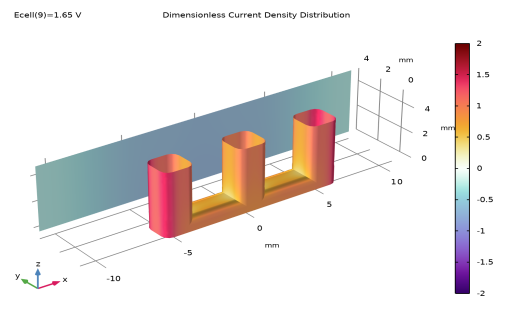
Figure 1: Current distribution and surrounding concentration field of a wire mesh electrode.
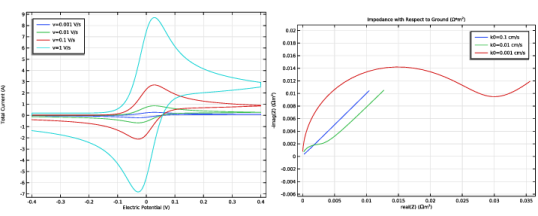
Possible applications include the study and design of chlor-alkali and chlorate electrolysis, water electrolysis for hydrogen and oxygen production, waste water treatment, desalination of seawater, electrophoretic separation of proteins, fundamental electrochemical studies in electrocatalysis and electroanalysis, and sensors for glucose, pH, hydrogen, and other gases. In the field of electroanalysis, the Electrochemistry Module offers tailor-made interfaces for cyclic voltammetry and impedance analysis (Figure 2).
Figure 2: Simulated cyclic voltammograms (left) and Nyquist plots (right) in COMSOL Multiphysics.