In the Geometry toolbar,
Conversions menu, click
Midsurface (

). You can also right-click the
Geometry node and add this node from the
Conversions submenu.
From the Input objects list, choose
Manual (default) to select the objects you want to use as input in the
Graphics window. Click the
Activate Selection button to toggle between turning ON

and OFF

the
Input objects selections. Alternatively, choose
All objects to select all objects or choose
All nonconstruction objects to automatically select all objects that have not been marked as
Construction Geometry. If the geometry sequence includes user-defined selections above the
Midsurface node, these will also be available in the
Input objects list. A midsurface object is generated for each input object independently.
Select the Keep input objects checkbox to use the selected geometry objects for further geometry operations.
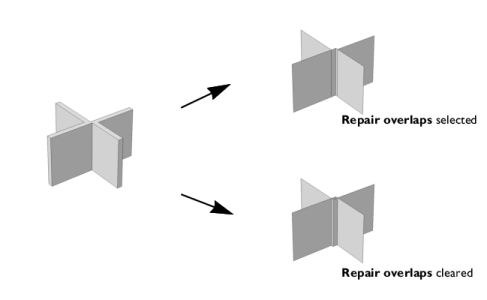
Select the Repair overlaps checkbox to repair areas where two or more generated midsurfaces overlap.
Click to select the Split in smooth components checkbox as needed. If this is selected, each output object is split into components, where each component is of manifold type and has smooth normal vector.
If you want to make the resulting entities contribute to a cumulative selection, select a cumulative selection from the Contribute to list (the default,
None, gives no contribution), or click the
New button to create a new cumulative selection (see
Cumulative Selections in the
COMSOL Multiphysics Reference Manual).
Select the Resulting objects selection checkbox to create predefined selections (for all levels — objects, domains, boundaries, edges, and points — that are applicable) in subsequent nodes in the geometry sequence. To also make all or one of the types of resulting entities (domains, boundaries, edges, and points) that the resulting objects consist of available as selections in all applicable selection lists (in physics and materials settings, for example), choose an option from the
Show in physics list:
All levels,
Domain selection,
Boundary selection,
Edge selection, or
Point selection. The default is
Domain selection, which is suitable for use with materials and physics defined in domains. For use with a boundary condition, for example, choose
Boundary selection. These selections do not appear as separate selection nodes in the model tree. Select
Off to not make any selection available outside of the geometry sequence.
If you have Named Selections that include entities on the input objects, select the
Propagate selections to resulting objects (selected by default) checkbox to update the selections to corresponding entities on the output objects, when possible. Clear the checkbox to not propagate the selection to the resulting objects. Selecting this option can be useful in combination with selecting the
Keep input objects checkbox so that the selections refer only to the input objects.
From the Construction geometry list choose
On to make the resulting objects available only in the feature’s geometry sequence. The default option
Inherit from input means that the resulting objects become construction geometry if all input objects are construction geometry. Choose
Off to never output construction geometry objects. For more information see
Construction Geometry in the
COMSOL Multiphysics Reference Manual.