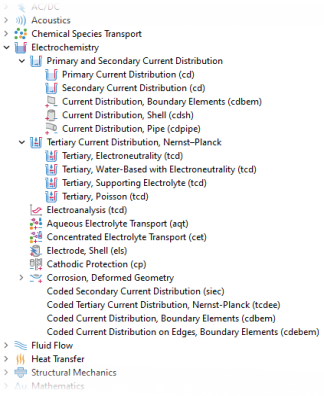
 ) interfaces combine primary, secondary, and tertiary current distributions described in the previous section with a Deformed Geometry interface to keep track of the geometrical changes caused by deposition or dissolution reactions on an electrode surface. See Figure 1 for an example. Note however that in the case where the thickness of the dissolving layer at the surface of the anode is negligible for the current distribution in the cell, a generic current distribution interface described in the previous section may also be used.
 Chemical Species Transport Chemical Species Transport |
|||||
 |
|||||
 |
|||||
 |
|||||
 |
|||||
 |
|||||
 |
|||||
 |
|||||
 Reacting Flow Reacting Flow |
|||||
 |
|||||
 Electrochemistry Electrochemistry |
|||||
  |
|||||
 |
|||||
 |
|||||
 |
|||||
 |
|||||
 |
|||||
 |
|||||
 |
|||||
 |
|||||
 |
|||||
 Corrosion, Deformed Geometry Corrosion, Deformed Geometry |
|||||
  |
|||||
 |
|||||
 Fluid Flow Fluid Flow |
|||||
 Porous Media and Subsurface Flow Porous Media and Subsurface Flow |
|||||
 |
|||||
 |
|||||
 |
|||||
 |
|||||
 Nonisothermal Flow Nonisothermal Flow |
|||||
 |
|||||
 Heat Transfer Heat Transfer |
|||||
 |
|||||
 Moving Interface Moving Interface |
|||||
 |
|||||
 |
|||||
 ); Secondary Current Distribution (
 ); and Tertiary Current Distribution, Nernst-Planck (
 ) interfaces are generic physics interfaces that can be used to model most kinds of electrochemical cells.
 ) interfaces may have to be used instead.
 ) interface assumes a perfectly mixed electrolyte and neglects the activation losses for the charge transfer reactions and should only be used for relatively fast kinetics, where the activation losses are substantially smaller than the ohmic losses. The assumption of a perfectly mixed electrolyte implies that the electrolyte conductivity is not affected by the magnitude of the currents.
 ) interface the activation overpotential for the electrochemical reactions, is taken into account in the analysis.
 ) interface can be used for solving primary and secondary current distribution problems on geometries based on edge (beam or wire) and surface elements. The interface uses a Boundary Element Method (BEM) formulation to solve for the charge transfer equation in an electrolyte of constant conductivity, where the electrodes are specified on boundaries or as tubes with a given radius around the edges. You typically use this interface in order to reduce the meshing and solver time for large geometries where a significant part of the geometry can be approximated as tubes along edges.
 ) interface models ionic current conduction in the tangential direction on a boundary. The physics interface is suitable for modeling thin electrolytes where the potential variation in the normal direction is negligible, for instance in atmospheric corrosion problems.
 ) interface models ionic current conduction in the tangential direction along an edge in 3D geometries. The physics interface is suitable for modeling corrosion phenomena in piping networks where the potential variation in the radial direction of the pipe is negligible.
 ) interface accounts for the transport of species through diffusion, migration, and convection and is therefore able to describe the effects of variations in composition on the corrosion process. The kinetic expressions for the electrochemical reactions account for both activation and concentration overpotential. The Electroneutrality and Water-based entries of the physics interface applies the equations of electroneutrality to the set of equations that describe the species and current balances. This also implies that all charged species in the electrolyte have to be defined in the simulations, except those species that are present at very low concentrations and can therefore be neglected in the balance of current. Finally, the Tertiary, Poisson entry does not assume electroneutrality in the electrolyte. Instead, the Poisson equation is solved to determine the potential distribution in the electrolyte.
 ) interface computes the potential and species concentration fields in a dilute aqueous electrolyte. The interface targets modeling of aqueous electrolytes featuring weak acids, weak bases, ampholytes, and generic complex species. This includes, but is not limited to, electrochemical systems and phenomena containing multiple homogeneous reactions coupled to electrode kinetics. The transport is defined by the Nernst-Planck equations in combination with electroneutrality and water autoprotolysis.
 ) is a generic interface for defining electrolyte transport. The electrolyte transport model is based on concentrated solution theory and can be applied to any type of electrochemical cell for an arbitrary number of electrolyte species. In contrast to the Tertiary Current Distribution, Nernst-Planck interfaces, the Concentrated Electrolyte Transport interface does not assume the presence of a neutral solvent, or a supporting electrolyte, of constant concentration.
 ) is customized for cathodic protection-related applications. It enables several customized boundary, edge, and point features suitable for cathodic protection modeling.
 ) models mass transport of diluted species in electrolytes using the diffusion-convection equation, solving for electroactive species concentrations. The physics interface is applicable for electrolyte solutions containing a large quantity of inert “supporting” electrolyte. Ohmic losses are assumed to be negligible. The physics interface includes tailor-made functionality for setting up cyclic voltammetry problems.
 ) is available under the Chemical Species Transport Branch. In combination with the Secondary Current Distribution interface (
 ), this physics interface can be used to model systems with supporting electrolytes. In these systems, the ions that give the largest contribution to the conduction of current are assumed to be present in uniform concentrations. An example of the use of these physics interfaces is to keep track of the transport of dissolved oxygen in an electrolytic solution while assuming that the concentration of ions is constant over the electrolyte.
 ) interface can be used for investigation of charge and ion distributions within the electrochemical double layer where charge neutrality cannot be assumed. A requisite when using this interface is that the double layer, which typically is in the range of tens of nanometers, is fully resolved in the mesh. The equations solved for are identical to the Electrochemistry>Tertiary Current Distribution, Poisson interface.
 ) is also available and describes species transport between the fluid, solid, and gas phases in saturated and variably saturated porous media. It applies to one or more species that move primarily within a fluid filling (saturated) or partially filling (unsaturated) the voids in a solid porous medium. The pore space not filled with fluid contains an immobile gas phase. With this, models including a combination of porous media types can be studied. This interface is suitable for modeling of corrosion and corrosion protection of metal structures in soil or rock, for example in oil and gas and civil engineering applications.
 ) interface can be used to investigate the transport of weak acids, bases, and ampholytes in aqueous solvents. The physics interface is typically used to model various electrophoresis modes, such as zone electrophoresis, isotachophoresis, isoelectric focusing, and moving boundary electrophoresis, but is applicable to any aqueous system involving multiple acid-base equilibria.
 ) can be used model reactions and translateral transport of surface (adsorbed) species.
 ) can be used to define systems of reacting species, electrode reactions and ordinary chemical reactions. As such, it serves as a reaction kinetics and material property provider to the space dependent transport interfaces, such as the Tertiary Current Distribution, Nernst-Planck interface, or Transport of Diluted Species interface.
 ) can be combined with the Corrosion Module interfaces to model free and forced convection in corrosion and corrosion protection.
 ) is used to model fluid movement through interstices in a porous medium where a homogenization of the porous and fluid media into a single medium is done. Together with the continuity equation and equation of state for the pore fluid (or gas) this physics interface can be used to model low velocity flows, for which the pressure gradient is the major driving force. Darcy’s law can be used in porous media where the fluid is mostly influenced by the frictional resistance within the pores. Its use is within very low flows, or media where the porosity is very small. The penetration of air through a porous structure is a classic example for the use of Darcy’s Law in corrosion and corrosion protection.
 ) is used to model porous flow when the size of the interstices is larger and the gradients in velocity and pressure of the fluid itself can be important. The Brinkman interface extends Darcy’s law to describe the dissipation of the kinetic energy by viscous shear, similar to the Navier–Stokes equations. The interface includes the possibility to add a Forchheimer drag term, which simulates viscous drag in very open beds where turbulent drag becomes important. Forchheimer drag is sometimes called Ergun’s equations. For very low speed flows or small geometrical length scales, you can also choose to neglect the inertial term (Stokes flow).
 ) and the Free and Porous Media Flow, Darcy interface (
 ) are useful for equipment that contain domains where free flow is connected to porous media, such as concrete structures immersed in water.
  ) have ready-made formulations for the contribution of Joule heating, and other electrochemical losses, to the thermal balance in corrosion and corrosion protection.
 ), Heat Transfer in Solids (
 ), and Heat Transfer in Porous Media (
 ), and account for conductive and convective heat transfer. These features interact seamlessly and can be used in combination in a single model.
 ) interface can be used in problems including deforming electrodes, subject to topological changes.