Introduction
The Corrosion Module is intended for the modeling and simulation of corrosion and corrosion protection of metal structures.
The module defines components in 1D, 2D, and 3D structures that describe the electrochemical reactions, corrosion reactions, and other surface reactions at the interface between a metal structure and a solution (acting as electrolyte). Also transport of ions and neutral species in the solution, homogeneous reactions, and current conduction in the metal structure can be included in the models. The simulations can be used to understand and avoid corrosion as well as to design and optimize corrosion protection.
The module allows for the simulation of systems at different scales and at different levels of detail. For example, a model may include a set of geometrically complex structures such as oil rigs, or other underwater structures, with several hundred sacrificial anodes protecting the structure. Though the structures may be complex, the vigorous mixing in the sea allows for a simpler description of the electrolyte. At the other end of the spectrum, a pitting or crevice corrosion model might have a simple geometry, but require a more complex description of the electrolyte solution, taking into account all ions and neutral species in the electrolyte, as well as including several competing reactions at the metal surfaces. In terms of size, geometric complexity, and complexity in the described phenomena, the Corrosion Module is able to handle these modeling extremes and anything in between.
Although most of the tutorials in the Corrosion Module Application Library focus on corrosion phenomena in water (aqueous electrolytes), other electrolyte systems can also be modeled.
The Applications
The modeling and simulation capabilities of the Corrosion Module cover processes such as galvanic, pitting, and crevice corrosion. The capabilities also include, for example, systems for cathodic protection, sacrificial anode protection, and anodic protection.
Figure 1 is a plot from a tutorial application, which is available in the module’s application library. The plot shows the galvanic corrosion of a magnesium metal surface in electronic contact with a steel surface, and an aqueous electrolyte in contact with both metal surfaces. The simulation accounts for the electrode kinetics for the anodic and cathodic reactions on both surfaces. The simulation predicts the change of the shape of the metal surface due to the dissolution of magnesium. This dissolution process dynamically deforms the geometry over time. This type of simulation may be relevant in the automotive, shipping, oil and gas, and refinery industries, where magnesium and aluminum are used together with steel to lower the weight of metal parts. In such applications, it is important to estimate the lifetime of the parts, and to assess the failure risk arising when using different materials in electronic contact that may be subjected to humid conditions.
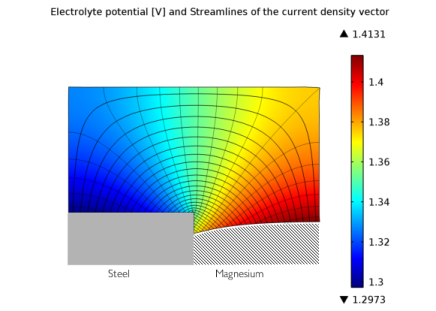
Figure 1: Galvanic corrosion of magnesium in electronic and electrolytic contact with steel. The initial shape of the magnesium and steel surface is planar.
Figure 2 shows the electrolyte potential on the surface of an oil rig steel structure immersed in seawater. The steel structure is protected by 40 sacrificial aluminum anodes. The simulation is able to predict whether the sacrificial anodes are positioned so that all parts of the steel structure are well protected. The positioning of the anodes in the model can be optimized to give the best possible protection prior to the structure and the anodes being deployed at sea. In addition, the expected lifetime of the sacrificial anodes can also be predicted, depending on location. This model is also available in the Corrosion Module Application Library.
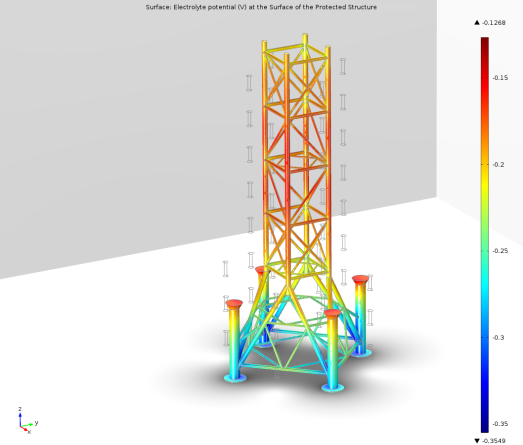
Figure 2: Electrolyte potential at the surface of an oil rig structure. The red areas are well protected, whereas the blue areas are more susceptible to corrosion.