Use the Block (

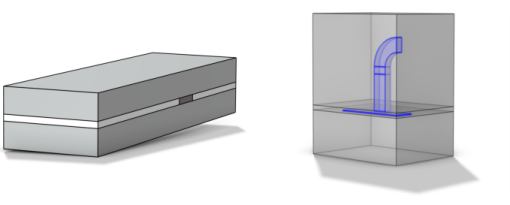
) node to create blocks (boxes) or bounding boxes in your geometry, as shown in
Figure 7-23.
To add a Block node, on the 3D
Geometry toolbar, click
Block (

). You can also right-click the
Geometry node to add this node from the context menu. Then enter the properties of the block using the following sections:
From the Type list, select
Solid (default) or
Surface to specify if the block is a solid object or a (hollow) surface object.
From the Defined by list, select
Size and position (default) to specify the width, depth, and height for the block as well as specify its position. Select
Bounding box (approximate) to create a block that approximately bounds a selection of objects or entities. A bounding box is useful to replace a complicated imported object with a block or to create a fluid domain around objects.
From the Orientation list, select
Principal axes (default) to let the orientation of the bounding box be determined by the principal axes of the input entities. Select
Manual to manually specify the orientation in the
Axis section.
This section is shown if Defined by is set to
Size and position. Define the edge lengths in the
Width,
Depth, and
Height fields. With the default axis (representing the
z-axis) and no rotation, the width, depth, and height correspond to the dimensions in the
x,
y, and
z directions, respectively.
This section is shown if Defined by is set to
Size and position. From the
Base list, choose
Center if the block is centered about the position, or choose
Corner (default) if the block has one corner in this position. For
Position type set to
Coordinates (default), enter the position using the
x,
y, and
z fields. For
Vertex, select a point in the
Graphics window. Click the
Activate Selection button to toggle between turning ON

and OFF

the
Position selections.
This section is shown if Defined by is set to
Bounding box (approximate). From the
Geometric entity level list, choose the level of the entities to bound:
Object (default),
Domain, or
Boundary,
Edge, or
Point. From the
Selection list, choose
Manual (default) to select the geometry objects or entities that you want to bound in the
Graphics window. If the geometry sequence includes user-defined selections above the
Block node, you can choose one of the selections from the
Selection list. Click the
Activate Selection button to toggle between turning ON

and OFF

the
Input objects selections. Alternatively, choose
All objects to select all objects or choose
All nonconstruction objects to automatically select all objects that have not been marked as
Construction Geometry.
For the setting Geometric entity level: Object, select the checkbox
Keep input objects (selected by default) to keep the objects that are bounded. Clear the checkbox to delete the selected objects.
This section is shown if Defined by is set to
Bounding box (approximate). Fill in the edit fields to enlarge the bounding box on one or more sides (or shrink it if the values are negative). See the definitions of the left, right, front, back, bottom, and top sides of the block in the
Layers section below.
Specify the direction of the block’s third axis — that is, the direction of the edges corresponding to the height. From the Axis type list, choose
x-axis,
y-axis, or
z-axis (the default) to obtain an axis aligned with the specified coordinate axis. Choose
Cartesian to enter a direction vector in the
x,
y, and
z fields. Choose
Spherical to enter the direction using the angles
theta (polar, zenith) and
phi (azimuth).
Specify the rotational angle about the block’s third axis in the Rotation field. When this angle is zero (the default), the block’s second axis is parallel to the
xy-plane.
The coordinate system in which the position, axis, and rotation angles above are interpreted. From the Take work plane from list, select
This sequence (the default) to use a work plane earlier in the same geometry sequence, or choose a part instance earlier in the sequence to choose a work plane from that part. From the
Work plane list, select
xy-plane (the default, for a standard global Cartesian coordinate system) or select any work plane defined above this node in the geometry sequence. If you choose a work plane, the work plane and its coordinate system appear in the
Graphics window, using an extra coordinate triad with the directions
xw,
yw, and
zw (which are then used to specify the block’s position).
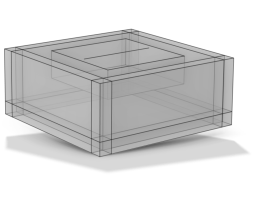
Layers can be used to create sandwich primitives by adding layers on one or more sides, as shown in Figure 7-23 and
Figure 7-24. This is especially useful when specifying artificial domains in the physics, such as Infinite Element Domains and Perfectly Matched Layers. Specify the thicknesses of layers in the
Layers table, and optionally a name for each layer. The outermost layer comes first. Select the checkboxes under
Layer position to specify where to apply the layers (see the graphics to the right of the checkboxes to see the definitions of the left, right, front, back, bottom, and top sides of the block). Each layer must have a minimal thickness (depending on the size of the geometry).
Select the Create Parameters checkbox to automatically create parameters for the coordinates and size of the block to be used in further geometry creation, mesh size settings, or physics set up. The created parameters can be seen in the variable tree that appears when pressing Ctrl+Space in an edit field in another feature.
Select the Resulting objects selection checkbox to create predefined selections (for all levels — objects, domains, boundaries, edges, and points — that are applicable) in subsequent nodes in the geometry sequence. To also make all or one of the types of resulting entities (domains, boundaries, edges, and points) that the block consists of available as selections in all applicable selection lists (in physics and materials settings, for example), choose an option from the
Show in physics (
Show in instances if in a geometry part) list:
All levels,
Domain selection,
Boundary selection,
Edge selection, or
Point selection. The default is
Domain selection, which is suitable for use with materials and physics defined in domains. For use with a boundary condition, for example, choose
Boundary selection. These selections do not appear as separate selection nodes in the model tree. Select
Off to not make any selection available outside of the geometry sequence. From the
Color list, choose a color for highlighting the resulting objects selection. See
Selection Colors.
When the Layers table is nonempty, select the
Create layer selections checkbox to create predefined domain selections for each specified layer and for the core domain. To also make the domains available as selections in all applicable selection lists (in physics and materials settings, for example), select the
Show in physics (
Show in instances if in a geometry part) checkbox (ON by default).
Select the Construction geometry checkbox to make the resulting objects available only in the feature’s geometry sequence. For more information, see
Construction Geometry.
