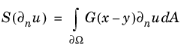
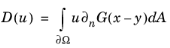
For the second term of the volume integral, since u is assumed to be a solution to Laplace’s equation
−∇ ·
(∇u) = 0:
The value of u over the entire domain
Ω is thus determined completely by the values of
u and the flux
n ·
∇u on the boundary. The integrals are not singular anywhere inside
Ω since the integral for each
y is taken over
x on the boundary where
x ≠ y. Furthermore, note that this relationship is not an equation but merely a representation of
u when we already know the solution and the flux on the boundary. Indeed, this representation is used to reconstruct the solution anywhere inside
Ω once the field and flux are solved for and known on the boundary.
The representation of u can be written more compactly as:







 for y inside Ω
 in Ω
in Ω