An Information Card Stack object is a specialized type of
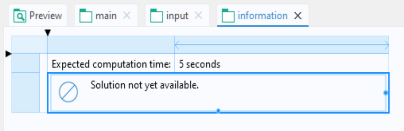
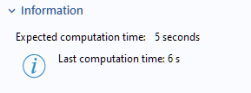
Card Stack object used to display information on the relationship between the inputs given by the user to an application and the solution. The figure below, taken from the Tubular Reactor app, shows a portion of a running application in which an information card stack is used together with information on the expected computation time.
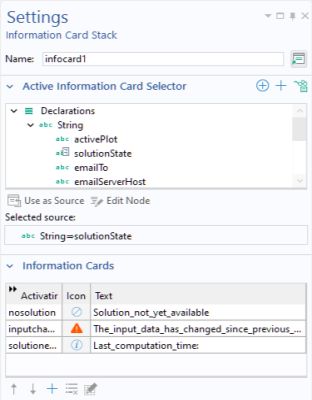
The figure below shows the Settings window where a string variable
solutionState is used as the source.
There are similarities with a Card Stack object, but for the
Information Cards, each card has an icon and text. In the figure above, the string variable values
nosolution,
inputchanged, and
solutionexists control which information card is shown.
You can also find information nodes with Last Computation Time under each study. The information node
Last Computation, found directly under the
Model node, will correspond to the computation time for the last computed study.
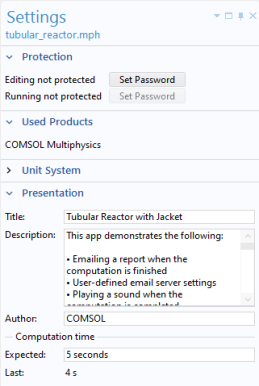
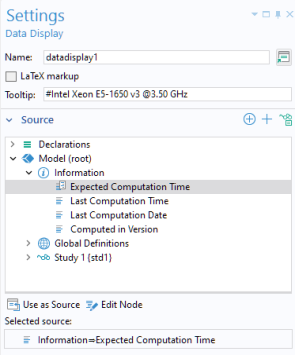
The Expected Computation Time take its data from the root node of the application tree, as shown below.