Macromechanics Modeling
Modeling a composite laminate and computing its response under loading is known as macromechanics analysis. The homogenized material properties of a lamina computed using a micromechanics analysis can be used as input to the macromechanics analysis.
In order to model a composite laminate, the following properties need to be specified:
•
Number of layers
•
Homogenized material properties of each layer
•
Orientation of the principal material directions
•
Thickness of each layer
•
Stacking sequence
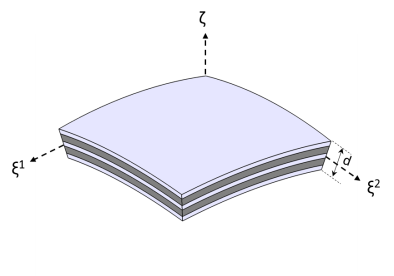
Figure 2-4:
A 3D representation of a composite laminate showing the total laminate thickness and the laminate coordinate system.
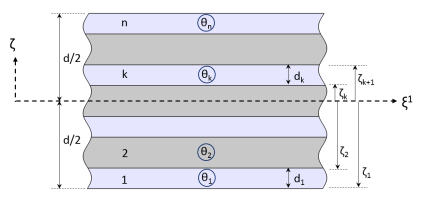
Figure 2-5:
Through-thickness (2D) representation of a composite laminate with n layers. The thickness and fiber orientation of each layer are indicated. The position of the reference surface with respect to the laminate is also shown.
In order to attach the layer definition to geometric surfaces, the following properties need to be defined:
•
Laminate coordinate system: These are the global directions for a composite laminate about which the stacking sequence is interpreted as shown in
Figure 2-4
.
•
Reference surface position: This is the position of the reference surface or geometric surface with respect to the midplane of the laminate as shown in
Figure 2-5
.
Once these definitions are specified, a regular finite element modeling approach can be used. It involves setting up the physics (loads, boundary conditions), creating a finite element mesh, performing various types of analysis, including static, dynamic, failure, buckling, and multiphysics analysis.