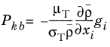
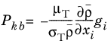
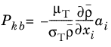
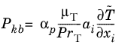
where gi is the gravitational acceleration. Applying a gradient-diffusion modeling approach gives
where σT is the turbulent Schmidt number.
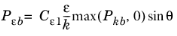
The production term in the ε equation is derived from the production term in the
k equation. Hence, the corresponding term in the
ε equation becomes
where Cε1 is the corresponding constant for every model (
1.44 for the Realizable k-
ε model). For the v2-f model
ε/k is changed to
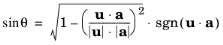
τ−1. The angle
θ is the angle between
u and
a, which is the vector with components
ai as defined in
Equation 3-284, and which accounts for the difference between buoyant vertical shear layers and buoyant horizontal shear layers:
Using the relation between k,
ε, and
ω, the buoyancy production term in the
ω equation of the k-
ω model can be derived as
Hence, the expressions for the various ε based and
ω based turbulence models differ only in terms of constants and damping functions.
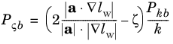
The v2-f turbulence model uses the gradient of the wall distance variable lw to compute the wall-normal direction, and relating the wall-normal turbulent fluctuations to the direction of gravity results in the following expression for buoyant production of
ζ:
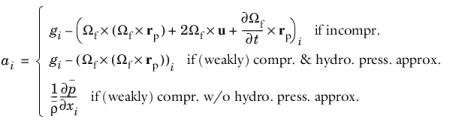
In a rotating frame, the effective acceleration vector a, with components
ai as defined in
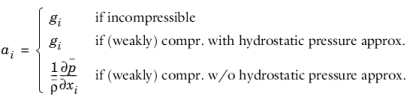
Equation 3-284, which is used in the expressions for the different production terms, should also take into account the fictitious forces arising from the non-inertial frame of reference. In this case, the effective acceleration
a is defined as follows:
Note that in the incompressible case the terms in the definition of a arise from the Reynolds averaging of the momentum equation, such that the acceleration terms from all volume forces appear, including the ones from the Coriolis and Euler forces. In the (weakly) compressible case, the momentum equation is Favre averaged, and the gradient of the pressure appears in the definition of
a. Approximating the gradient of the pressure by the hydrostatic pressure caused by gravity and the centrifugal force leads to the form of
a as in the second case in
Equation 3-291. See also the theory section for
Rotating Frame.