The Darcy’s Law Interface (

) is used for modeling fluid movement through interstices in a porous medium by homogenizing the porous and fluid media into a single medium. Together with the continuity equation and equation of state for the pore fluid (or gas) this physics interface can be used to model low velocity flows, for which the pressure gradient is the major driving force. The penetration of reacting gases into a tight catalytic layer, such as a washcoat or membrane, is a classic example for the use of Darcy’s Law.
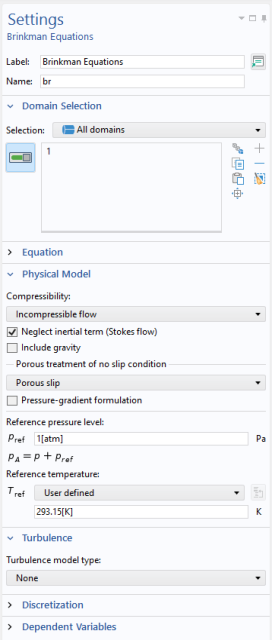
The Brinkman equations extend Darcy’s law to describe the dissipation of momentum by viscous shear, similar to the Navier–Stokes equation. Consequently, they are well suited to model transitions between slow flow in porous media, governed by Darcy’s law, and fast flow in channels described by the Navier–Stokes equations.
The Free and Porous Media Flow, Brinkman Interface (

) is useful for modeling equipment that contains domains with both free flow and porous media flow, such as packed-bed reactors and catalytic converters. It should be noted that if the porous medium is large in comparison with the free channel, and you are not primarily interested in results in the vicinity of the interface, you can always couple a Fluid Flow interface to a Darcy’s Law interface, to make your overall model computationally cheaper.
The Free and Porous Media Flow, Darcy Interface (

) is a multiphysics interface that is used to model coupled free and porous media flow. It uses a Darcy’s Law interface in the porous domain and a Laminar Flow interface in the free-flow domain, which are coupled over the free-porous interface by the Free and Porous Media Flow Coupling multiphysics boundary feature. This coupling feature provides several options for modeling the tangential velocity component of the free flow at the free-porous interface.
The Two-Phase Darcy’s Law Interface (

) has the equations and boundary conditions for modeling two-phase fluid movement through interstices in a porous medium using Darcy’s law. The two fluids are considered immiscible, and in general, have different densities and viscosities.
 ) is used to model incompressible flow. You can also choose to model compressible flow at speeds less than Mach 0.3, but you have to maintain control over the density and any of the mass balances that are deployed to accomplish this. Furthermore, you can select the Stokes–Brinkman flow feature to reduce the influence of inertial effects (see