Large Eddy Simulation
Large Eddy Simulations offer an alternative approach to turbulent flow simulations as compared to the RANS approach. In LES, the larger three-dimensional, unsteady eddies are resolved, whereas the effect of the smaller eddies is modeled. This requires the simulations to be three-dimensional and time dependent. The velocity, density and mass fraction fields are divided into resolved, (u, ρ, ωi), and unresolved, (u', ρ', ω'i). The unresolved scales are assumed to be orthogonal to the inner-product space of the resolved scales and to vanish on ∂Ω, the boundaries of the domain Ω.
Inserting the variable decomposition into the conservative form of the mass-transport equation, projecting onto the finite element spaces of the resolved mass fractions, and neglecting the influence of unresolved scales on the diffusion coefficients yields
(8-70)
The unresolved mass fractions are modeled in terms of the strong-form residuals
and the unresolved density depends on the unresolved mass fractions, the unresolved pressure and the unresolved temperature according to
See Theory for the Large Eddy Simulation Interfaces in the Single-Phase Flow Interfaces chapter for further details.
When the RBVMWV method is used, the following term is added to the right-hand side of Equation 8-70
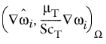
and when the Smagorinsky method is used, the term on the left-hand side of Equation 8-70 is replaced by
Note that equal-order interpolation is required for all dependent variables in LES.
When automatic wall treatment is applied in an LES model, a flux condition is imposed for the mass-transport equation. The mass flux between the fluid with mass fraction ωi, f and a wall with mass fraction ωi, w, is
where uτ is the friction velocity and is the dimensionless mass fraction, given by
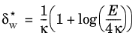
for and
for , where