Battery Modeling
The Battery Design Module has a number of physics interfaces to model batteries. Choice of physics interface depends on the overall purpose of the model.
Detailed Cell Models
When studying the cell chemistry, aging, or high charge-discharge rates one typically resolves the different layers of the battery using space-dependent models on a micrometer scale, whereas coarser models for computing heat sources or predicting the voltage behavior for low or moderate charge-discharge rates may use a more lumped modeling approach.
Space-dependent battery models often model unit cells that consist of:
a) Current collectors and current feeders
b) Porous or solid metal electrodes
c) The electrolyte that separates the anode and cathode
To exemplify, the following describes some of the charge and discharge processes in a rechargeable battery.
During discharge, chemical energy is transferred to electric energy in the charge transfer reactions at the anode and cathode. The conversion of chemical to electric energy may involve electrochemical reactions, transport of electric current, transport of ions and neutral species in the electrolyte, mass transport in the electrode particles, fluid flow, and the release of heat in irreversible losses.
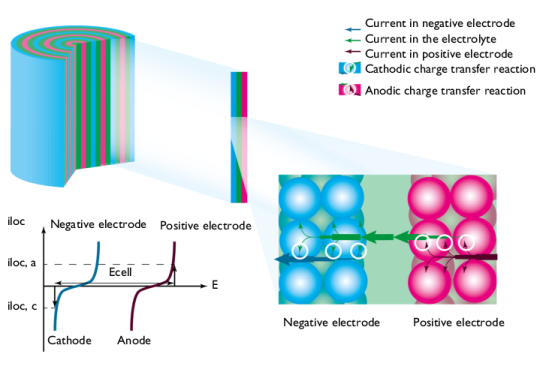
Figure 2 shows a schematic picture of a typical discharge process.
Figure 2: Direction of the current and charge transfer current during discharge in a battery with porous electrodes.
The current enters the cell from the current feeder at the negative electrode. An anodic charge transfer reaction occurs at the interface between the electrode material and electrolyte contained in the porous electrode, also called the pore electrolyte.
From the pore electrolyte, the current is conducted by the transport of ions through the electrolyte that separates the positive and negative electrode (via separator or reservoir) to the pore electrolyte in the positive electrode.
At the interface between the pore electrolyte and the surface of the particles in the positive porous electrode, a cathodic charge transfer reaction transfers the ionic electrolyte current to current conducted by electrons in the positive electrode.
The current then leaves the cell through the current collector. The conduction of current and the electrochemical charge transfer reactions will release heat due to ohmic losses, activation losses, and other irreversible processes.
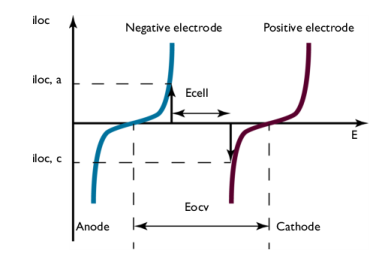
Looking closer at the charge transfer reactions on both electrode interfaces, Figure 3 describes the polarization of the electrodes during discharge. The graph plots the charge transfer current density, iloc, as a function of the electrode potential, E.
Figure 3: Electrode polarization during discharge. The figure is same as inset of Figure 2.
The negative electrode is polarized anodically during discharge, a positive current as indicated by the arrow in Figure 3. The potential of the negative electrode subsequently increases. The charge-transfer reaction involves oxidation of either the electrode material or of reactants in the electrolyte. The shape of the polarization curve is governed by the electrode kinetics for the specific materials. The resulting local current density is denoted iloc, a.
Similarly, the potential at the positive electrode decreases though cathodic polarization. During the cathodic charge transfer reaction the electrode material or reactants are reduced, with the observed current density being denoted iloc, c.
Figure 3 also shows that the potential difference between the electrodes, here denoted Ecell, decreases during discharge compared to the open cell voltage, here denoted Eocv. In this description losses in Ecell through ohmic resistance and mass transport in electrolyte and electrode particles were neglected. Both effects may occur in many batteries and can be included in a model with the Battery Design Module functionalities.
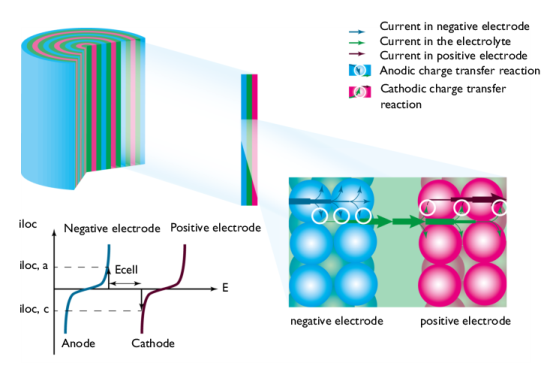
Figure 4 shows the reversed processes in the battery during charge. Electric energy is transformed to chemical energy stored in the battery.
Figure 4: During charge, the positive electrode acts as the anode while the negative one acts as the cathode. The cell voltage increases (at a given current) compared to the open cell voltage. Note: direction of the currents is reversed here.
The current enters the cell at the positive electrode. Here, during charge, an oxidation of the reactants takes place through an anodic charge transfer reaction. The positive electrode is polarized anodically, with a positive current, and the electrode potential increases.
The current is then conducted through the positive electrode pore electrolyte, through the electrolyte in the separator (or reservoir), to the pore electrolyte in the negative electrode.
In the negative electrode, a reduction takes place through a cathodic charge transfer reaction. The negative electrode is polarized cathodically and the electrode potential decreases.
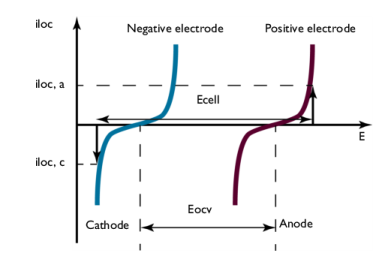
Figure 5 depicts the polarization of the electrodes during charge.
Figure 5: Electrode polarization during charge.
During charge, the cell voltage Ecell is higher than the open circuit voltage Eocv.
Again, losses through ohmic resistance and mass transport in electrolyte and electrode particles were neglected. They would further increase Ecell.
The battery processes and phenomena described in the figures above can all be investigated using the Battery Design Module. The physics interfaces included in the module allow you to investigate the influence on battery performance and thermal management of parameters such as the:
Lumped Models
When modeling larger systems such as battery packs, it can be practical to neglect detailed descriptions of the phenomena occurring within the individual batteries. Many details about the battery cell may not be known to the modeler, and computational costs (memory and computational time) may favor less complex models. For these cases one often replaces the detailed cell model by simpler zero-dimensional cell elements, forming an equivalent circuit, lumped battery, or single-particle model. For instance, instead of a detailed mass and charge balance of charge-carrying ions in the electrolyte phase along the length of the negative electrode, the separator, and the positive electrode, all voltage contributions from these phenomena are lumped into a single resistor.
In a battery pack model a number of these zero-dimensional models for each battery cell are then combined to define the cell-to-cell current distribution of the pack.