Introduction
The Battery Design Module offers a wide range of functionality for modeling and simulation of batteries: from the fundamental processes in the electrodes and electrolytes of batteries to cell-to-cell temperature and current distributions in battery packs. These simulations may involve the transport of charged and neutral species, current conduction, fluid flow, heat transfer, and electrochemical reactions in porous electrodes.
You can use this module to investigate the performance of batteries at different operating conditions and for different electrode configurations, separators, current collectors and feeders, materials, and chemistry. The description of the involved processes and phenomena may be defined in a fairly detailed manner, allowing you to apply different hypotheses to gain an understanding of the investigated systems. With these detailed models you can study the influence of different electrode materials, pore distribution, electrolyte composition, and other fundamental parameters on various aspects such as battery performance, as well as capacity and power fade.
The module also allows for more lumped (“black-box”) modeling approaches where detailed knowledge of the battery chemistry is not required. Such lumped models can be used for investigating cell-to-cell dynamics in packs, thermal management, as well as battery dynamics in electrical circuit simulations. The small set of parameters used in lumped models are well suited for fitting to load-cycle experimental data. Parameter estimation tools, implemented with optimization solvers, are also included in the Battery Design Module.
You can couple the battery models to other physics such as heat transfer, fluid flow, structural mechanics, and chemical species transport in order to study phenomena like aging, heat dissipation effects and stress-strain relationships.
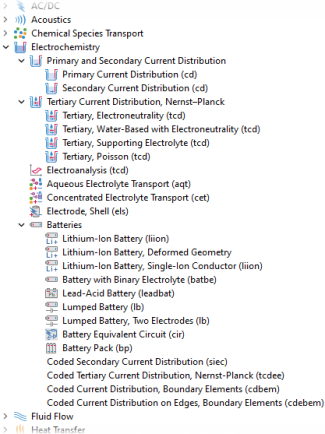
Figure 1:
The 3D physics interfaces for the Battery Design Module, as shown in the Model Wizard, with the Electrochemistry branch fully expanded.
The figure above shows the available physics interfaces in the Battery Design Module under the Electrochemistry (
) branch. These electrochemistry interfaces are based on the conservation of current, charge, chemical species, and energy. The Battery Interfaces form the basis for battery cell and pack modeling.
The Chemical Species Transport (
), the Fluid Flow (
) and the Heat Transfer (
) interfaces are extended with functionality for battery modeling, for instance features for handling porous media. The different physics interfaces are further discussed below.
 ) branch. These electrochemistry interfaces are based on the conservation of current, charge, chemical species, and energy. The Battery Interfaces form the basis for battery cell and pack modeling.
 ), the Fluid Flow (
 ) and the Heat Transfer (
 ) interfaces are extended with functionality for battery modeling, for instance features for handling porous media. The different physics interfaces are further discussed below.