Additional Examples from the Application Libraries
The Acoustics Module application library has other tutorials available as well as advanced industrial and verification models. Short explanations and examples are given below for a cross section of these models. Go to
The Application Libraries Window
to learn how to access these model files from COMSOL Multiphysics.
Eigenmodes in a Muffler
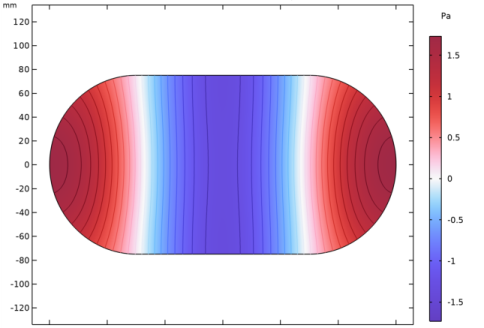
In this model, the propagating modes in the chamber of an automotive muffler are computed. The geometry is a cross section of the chamber as described in the Absorptive Muffler example in this guide.
The purpose of the model is to study the shape of the propagating modes and to find the cutoff frequencies. The boundary mode analysis in COMSOL is sometimes referred to as semi-analytical finite element or SAFE. As discussed in the Absorptive Muffler tutorial, some of the modes significantly affect the damping of the muffler at frequencies above the cutoff. In the Eigenmodes in Muffler model, modes with cutoff frequencies up to 1500 Hz are studied.
Figure 14:
First fully symmetric propagation mode of the muffler chamber (with no absorbing liner). The plot shows the real part of the pressure.
Piezoacoustic Transducer
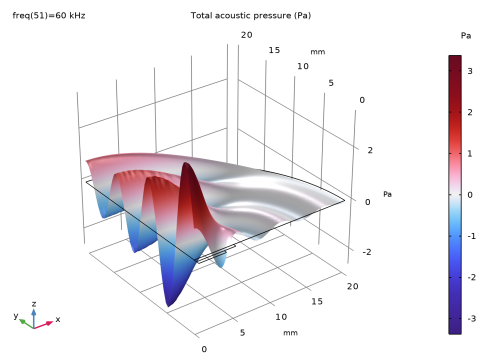
A piezoelectric transducer can be used either to transform an electric current to an acoustic pressure field or, the opposite, to produce an electric current from an acoustic field. These devices are generally useful for applications that require the generation of sound in air and liquids. Examples of such applications include phased array microphones, ultrasound equipment, inkjet droplet actuators, sonar transducers, and devices for drug discovery, bioimaging, and acousto-biotherapeutics.
Figure 15:
Surface and height plot of the pressure distribution created by the piezoactuator at f = 60 kHz.
Loudspeaker Driver in a Vented Enclosure
An important class of acoustic models are transducers — that is, electromechanical acoustic transducers. Transducers are true multiphysics models that often in addition to acoustics necessitate a structural mechanics and an electromagnetic interface is added. One such class are loudspeakers (presented here), another are microphones presented below.
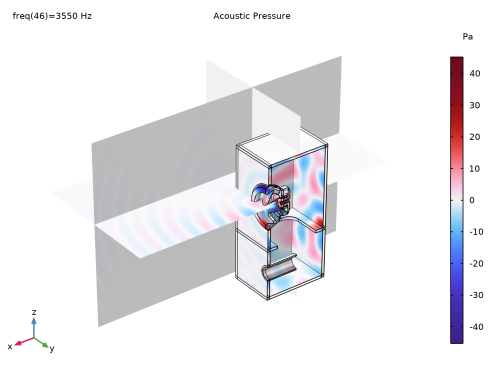
This model of a boxed loudspeaker lets you apply a nominal driving voltage and extract the resulting sound pressure level in the outside room as a function of the frequency, including on-axis response and directivity plots. The electromagnetic properties of the driver are supplied from the Loudspeaker Driver model (available with the AC/DC Module). The model uses the Acoustic–Shell Interaction interface and therefore requires the Structural Mechanics Module. The model combines acoustics modeled with FEM and BEM, as well as Solid Mechanics for the cabinet and shells for the driver. The structural modes of the speaker are also analyzed.
Figure 16:
Pressure distribution at 3550 Hz.
The Brüel & Kjær 4134 Condenser Microphone
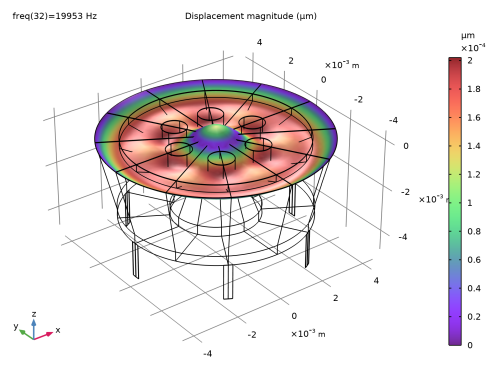
Another type of transducer is the microphone. This is a model of the Brüel and Kjær 4134 condenser microphone. The geometry and material parameters are those of the microphone. The modeled sensitivity level is compared to measurements performed on an actual microphone and shows good agreement. The membrane deformation, pressure, velocity, and electric field are also determined. The model requires the Acoustics Module, the AC/DC Module, and the Structural Mechanics Module.
Figure 17:
Deformation of the microphone membrane (diaphragm) at 20 kHz. The geometry is courtesy of Brüel & Kjær.
This concludes this introduction.