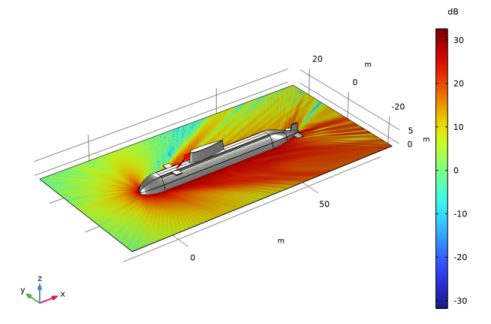
The Pressure Acoustics branch ( ) has interfaces where the sound field is described by the pressure p
. The physics interface solves acoustic problems in the frequency domain using the Pressure Acoustics, Frequency Domain interface (

), where the Helmholtz equation is solved. Transient systems are modeled using the Pressure Acoustics, Transient interface (

), where the classical wave equation is solved. Nonlinear effects can be included here using the Nonlinear Acoustics (Westervelt) feature. The Boundary Mode Acoustics interface (

) is used to study propagating modes in waveguides and ducts (at a given frequency only a finite set of wave shapes can propagate over a long distance).
|
|
|
|
|
|
 Acoustics Acoustics
|
|
|
 Pressure Acoustics Pressure Acoustics |
|
|
|
|
|
|
eigenfrequency; frequency domain; frequency domain, modal; adaptive frequency sweep; mode analysis (2D and 1D axisymmetric models only); boundary mode analysis (3D and 2D axisymmetric models only)
|
|
|
|
|
|
|
|
|
|
|
|
|
|
|
|
|
|
|
|
|
|
|
|
|
|
|
|
|
|
|
|
|
|
|
|
|
|
|
|
|
|
|
|
|
 Elastic Waves Elastic Waves |
|
|
|
|
|
|
|
|
|
|
|
|
|
|
|
|
|
|
|
|
|
|
|
|
|
|
|
|
|
|
 Acoustic–Structure Interaction Acoustic–Structure Interaction |
|
|
|
|
|
|
|
|
|
|
|
|
|
|
|
|
|
|
|
|
|
|
|
|
|
|
|
|
|
|
|
|
|
|
|
|
|
|
|
|
|
|
|
|
|
|
|
|
|
|
|
|
|
|
|
|
|
|
|
|
|
|
|
|
|
 Aeroacoustics Aeroacoustics |
|
|
|
|
|
|
|
|
|
|
|
|
|
|
|
|
|
|
|
|
|
|
|
|
|
|
|
|
|
|
|
|
|
|
|
|
|
|
|
|
|
|
|
|
|
|
|
|
|
|
|
|
|
|
|
|
|
|
|
|
|
|
|
|
|
|
|
|
|
|
|
|
 Thermoviscous Acoustics Thermoviscous Acoustics |
|
|
|
|
|
|
|
|
|
|
|
|
|
|
|
|
|
|
|
|
|
|
|
|
|
|
|
|
|
|
|
|
|
|
|
|
|
|
|
|
|
|
|
|
|
|
|
|
|
|
|
|
|
|
|
|
|
|
|
|
|
|
|
|
|
 Ultrasound Ultrasound |
|
|
|
|
|
|
|
|
|
|
|
|
|
|
|
|
 Geometrical Acoustics Geometrical Acoustics |
|
|
|
|
|
|
|
|
|
|
|
|
|
|
|
|
 Pipe Acoustics Pipe Acoustics |
|
|
|
|
|
|
|
|
|
|
|
|
|
|
|
|
 Acoustic Streaming Acoustic Streaming |
|
|
|
|
|
|
|
|
|
|
|
|
|
|
 Structural Mechanics Structural Mechanics |
|
|
|
|
|
stationary; eigenfrequency; eigenfrequency, prestressed; mode analysis; time dependent; time dependent, modal; time dependent, modal reduced-order model; frequency domain; frequency domain, modal; frequency domain, prestressed; frequency domain, prestressed, modal; frequency domain, modal reduced-order model; frequency domain, AWE reduced-order model
|
|
|
 Piezoelectricity Piezoelectricity |
|
|
|
|
|
|
|
|
|
 Magnetomechanics Magnetomechanics |
|
|
|
|
|
|
|
|
|
|
|
|
|
|
|
|
|
|
|
|
|
|
|
|
|
|
|
|
|
|
|
|
|
|
|
|
|
|
|
|
|
|
|
|
|
|
|
|
|
|
|
|
|
|
|
|
1 This physics interface is included with the core COMSOL package but has added functionality for this module.
2 Requires both the Structural Mechanics Module and the Acoustics Module.
3 This physics interface is a predefined multiphysics coupling that automatically adds all the physics interfaces and coupling features required.
4 Requires the addition of the AC/DC Module.
5 Requires both the MEMS Module and the Acoustics Module.
|
 ) solves the Helmholtz equation using the boundary element method (BEM). The interface is fully multiphysics enabled and couples seamlessly with the finite element based interfaces, both acoustic and structural. The Pressure Acoustics, Time Explicit (
 ) interface uses a time explicit method based on discontinuous Galerkin finite elements to efficiently solve large transient problems. This physics interface can also be solved on a GPU. It can also be coupled to the Elastic Waves, Time Explicit interface. Porous domains can be modeled in the time domain with this interface. Finally, two interfaces exist to model high-frequency acoustics: the Pressure Acoustics, Asymptotic Scattering interface (
 ) for scattering problems, and the Pressure Acoustics, Kirchhoff–Helmholtz interface (
 ) for radiation problems.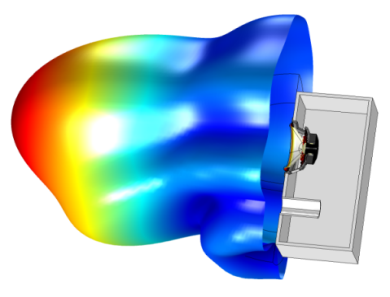
 ) includes physics interfaces and multiphysics interfaces for modeling the propagation of linear elastic waves in solids, porous materials, and piezoelectric materials. If necessary, the interfaces are readily coupled to fluid domains using the built-in multiphysics couplings.
 ), for modeling elastic waves in solids. The Port boundary condition is specifically implemented to model and handle various propagating modes in elastic waveguide structures.
 ), for precisely modeling the propagation of sound in a porous material (isotropic or anisotropic). It includes the two-way coupling between the deformation of the solid porous matrix and the pressure waves in the saturating fluid. The physics interface solves Biot’s equations in the frequency domain (using a u-p formulation). It includes two formulations for the loss mechanisms: The Biot (viscous losses) for modeling rocks and soils and the Biot–Allard (or Biot-JCA, that includes thermal and viscous losses) for sound absorbing materials in air.
 ), for modeling the propagation of linear elastic waves in solids using the discontinuous Galerkin, time explicit formulation. The interface is suited for modeling large problems with a memory efficient method.
 ) multiphysics interface, for modeling linear elastic waves in piezoelectric materials using the discontinuous Galerkin, time explicit formulation. The interface is suited for modeling large problems with a memory efficient method.
  ) has interfaces that apply to phenomena where the fluid pressure causes a load on the solid domain, and the structural acceleration affects the fluid domain across the fluid-solid boundary.
 ) and Acoustic–Solid Interaction, Transient (
 ) multiphysics interfaces.
 ) and Acoustic–Shell Interaction, Transient (
 ) multiphysics interfaces.
 ) and Acoustic–Piezoelectric Interaction, Transient (
 ) multiphysics interfaces, which support solving and modeling the electric field in a piezoelectric material. The piezoelectric coupling can be in stress-charge or strain-charge form.
 ) and Acoustic–Poroelastic Waves Interaction (
 ) multiphysics interfaces.
 ) multiphysics interface.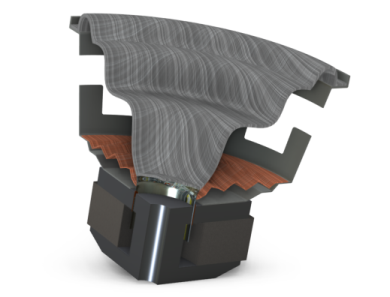
 ). The coupling between the fluid mechanics and the acoustics is based on solving the set of linearized governing equations using stabilized finite elements methods. In this way, you solve for the acoustic variations of the acoustic variables on top of a stationary background mean flow. Different physics interfaces exist that solve the governing equations under various physical approximations.
 ) and Linearized Navier–Stokes, Transient (
 ) interfaces are used for aeroacoustic simulations that can be described by the linearized Navier–Stokes equations solving for the acoustic variations in pressure, velocity, and temperature. The Linearized Navier–Stokes, Boundary Mode interface (
 ) is used to compute and identify propagating and nonpropagating modes in waveguides and ducts in the presence of a background flow.
 ) and the Linearized Euler, Transient interface (
 ) solve the Linearized Euler equations. They are used to compute the acoustic variations in density, velocity, and pressure in the presence of a stationary background mean-flow that is well approximated by an ideal gas flow. The Linearized Euler, Boundary Mode interface (
 ) is used to compute and identify propagating and nonpropagating modes in waveguides and ducts in the presence of a background flow.
 ) and the Linearized Potential Flow, Transient (
 ) interfaces model the interaction of a stationary background potential flow with an acoustic field. These physics interfaces are only suited for cases where the flow is inviscid and, being irrotational, has no vorticity. The background flow is typically solved for using the Compressible Potential Flow interface (
 ). The Linearized Potential Flow, Boundary Mode interface (
 ) is used to study boundary mode acoustic problems, identifying propagating and nonpropagating modes, in a background flow field. It is typically used to define sources at the inlet of ducts using the port boundary condition.
 ) interface is used to map imported fluid flow data, in the CGNS format, onto an acoustics mesh. The interface also integrates with the necessary multiphysics couplings.
 ) are used to accurately model acoustics in geometries with small dimensions. Near walls viscous and thermal boundary layers (penetration depths) exist. Here, viscous losses due to shear and thermal conduction become important because of large gradients. For this reason, it is necessary to include thermal conduction effects and viscous losses explicitly in the governing equations. Thermoviscous acoustics is, for example, used when modeling the response of small transducers like microphones and receivers. Other applications include analyzing feedback in hearing aids and in mobile devices, or studying the damped vibrations of MEMS structures. In this case, a coupling exists to the Thermoelasticity interface for detailed damping assessment. In the time domain, nonlinear effects can be modeled using the Nonlinear Thermoviscous Acoustics Contributions feature.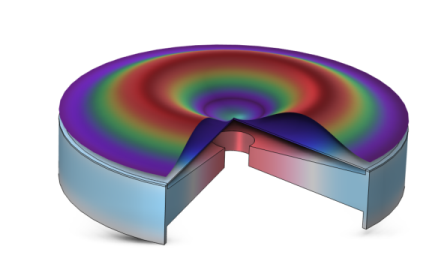
 ), the governing equations are implemented in the time-harmonic formulation and solved in the frequency domain. The interface is given in the scattered field formulation. Both mechanical and thermal boundary conditions exist. The interface exists in a time domain formulation, the Thermoviscous Acoustics, Transient interface (
 ). The Thermoviscous Acoustics, Boundary Mode interface (
 ) is used to compute and identify propagating and nonpropagating modes in waveguides and ducts. The interface performs a boundary mode analysis on a boundary, inlet, or cross section of a waveguide or duct of small dimensions. The Thermoviscous, SLNS Approximation interface (
 ) uses a fast approximative formulation of the equations that is valid in most cases. Several multiphysics interfaces involving thermoviscous acoustics also exist:
 ) that includes Pressure Acoustics, Frequency Domain and the Acoustics–Thermoviscous Acoustics Boundary coupling feature. Coupling the thermoviscous acoustics domain to a pressure acoustics domain is also straightforward, with the predefined multiphysics condition.
 ) is available to solve coupled vibroacoustic problems. This can, for example, be used to model small electroacoustic transducers or damping in MEMS devices. It includes Solid Mechanics and the predefined multiphysics coupling to Thermoviscous Acoustics.
 ) is used for modeling the interactions between shells and acoustics in small dimensions. This can, for example, be used to analyze the damped vibrations of shells in hearing aids and prevent feedback problems.
 ) and the Thermoviscous Acoustic–Thermoelasticity Interaction, Transient (
 ) interfaces are specialized multiphysics interfaces for modeling the coupled effects of viscous, structural, and thermal damping in a vibroacoustic setup.
 ).
). ) interface which is used to solve large transient linear acoustic problems containing many wavelengths in a stationary background flow. In general, the interface is suited for modeling the propagation of acoustic signals over large distances relative to the wavelength, for example, linear ultrasound problems. Application areas include ultrasound flowmeters and other ultrasound sensors where time of flight is an important parameter.
 ) interface is used to model the propagation of high amplitude nonlinear acoustic waves. Special functionality exists to capture shocks. Application areas include biomedical applications, for instance, ultrasonic imaging and high-intensity focused ultrasound (HIFU). The applications are not restricted to ultrasound.
 ) and the Pipe Acoustics, Frequency Domain (
 ) interfaces are used to model the propagation of sound waves in 1D flexible pipe systems. The equations are formulated in a general way to include the effects of the pipe wall compliance and allow the possibility of a stationary background flow. The pipe interfaces can be coupled to pressure acoustics domains using the built-in Acoustic–Pipe Acoustics Connection multiphysics coupling.
 ) branch. Both interfaces feature dedicated domain and boundary multiphysics couplings to model acoustic streaming phenomena, that is, the generation of flow by an acoustic field. The Acoustic Streaming from Pressure Acoustics (
 ) couples Pressure Acoustics, Frequency Domain to Laminar Flow using an effective theory. The Acoustic Streaming from Thermoviscous Acoustics (
 ) couples Thermoviscous Acoustics, Frequency Domain to Laminar Flow including full resolution of the acoustic boundary layers.


