Virtual Gap Method
For the magnetic case it can be shown that extra accuracy can be gained by expressing the Maxwell stress tensor in vacuum in terms of the tangent magnetic field
H
t
and normal magnetic flux density
B
n
.
It is possible to introduce the magnetic flux density in a vacuum gap that is just outside the object (virtual gap) as
resulting in the Maxwell stress tensor
.
The complete derivation of the Maxwell stress tensor is performed later in this chapter. Similarly to that case, the force can be found as the boundary integral of the contraction of the dot product of the above tensor with the outward pointing normal to the solid object.
The use of these variables make it possible to compute the forces of objects in contact. This also enables computation of the forces on boundaries that are mimicking volumetric objects such as in magnetic shielding.
If there are no surface currents, the tangential magnetic field is continuous and there is no ambiguity on its definition, then some attention must used if surface currents are present. In such a case, the force on the volumes in contact with the surface can be found in the same way, paying attention to use the tangential magnetic field from inside the considered solid. In addition, there is also the boundary contribution to the force from the boundary currents
J
t
that is
.

 .
.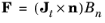 .
.