 ) for frequency-domain modeling and time-domain modeling, respectively. It also includes the Laser Heating interface, available under Heat Transfer. Also see Physics Interface Guide by Space Dimension and Study Type.
 Heat Transfer Heat Transfer |
|||||
 Electromagnetic Heating Electromagnetic Heating |
|||||
 |
|||||
 Optics Optics |
|||||
 Wave Optics Wave Optics |
|||||
 |
|||||
 |
|||||
 |
|||||
 |
|||||
 |
|||||
 |
|||||
|
1 This physics interface is a predefined multiphysics coupling that automatically adds all the physics interfaces and coupling features required.
|
|||||
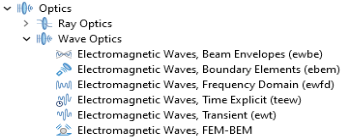
 ) solves a frequency-domain wave equation for the electric field. The sources can be in the form of point dipoles, line currents, or incident fields on boundaries or domains. It is used primarily to model electromagnetic wave propagation in different media and structures. Variants of the formulation solves an eigenvalue problem to find the eigenfrequencies of a structure or, at a prescribed frequency, solves an eigenvalue problem to find the propagating modes in waveguides and transmission lines. Some typical applications that are simulated with the interface are waveguides, gratings, and scattering from small particles.
 ) solves one or two frequency-domain wave equations for the electric field envelope(s). The electric field is represented as the product of the solved for electric field envelope and a rapidly varying prescribed phase function. As the electric field envelopes has a slower spatial variation than the electric field, a coarse mesh can be used. Thus, the Electromagnetic Waves, Beam Envelopes interface is suitable for simulations of optically large structures (that is, structures that are much larger than the wavelength). The sources can be in the form of incident fields on boundaries, surface currents, or electric or magnetic fields on boundaries. The interface can be used for propagation problems at a fixed frequency and for finding eigenfrequencies in a resonant structure. Some typical applications that are simulated with the interface are waveguide structures, like directional couplers, nonlinear optical phenomena, and laser beam propagation.
 ) solves a frequency-domain wave equation for the electric field. The formulation is based on the boundary element method (BEM) and requires the availability of a Green’s function. Thus, the physics interface solves the vector Helmholtz equation for piecewise-constant material properties.
 ) solves a system of two first-order partial differential equations (Faraday’s law and Maxwell-Ampère’s law) for the electric and magnetic fields using the Time Explicit Discontinuous Galerkin method. The sources can be in the form of volumetric electric or magnetic currents or electric surface currents or fields on boundaries. It is used primarily to model electromagnetic wave propagation in linear media. Typical applications involve the transient propagation of electromagnetic pulses.
 ) solves a time-domain wave equation for the electric field. The sources can be in the form of point dipoles, line currents, or incident fields on boundaries or domains. It is used primarily to model electromagnetic wave propagation in different media and structures when a time-domain solution is required — for example, for nonsinusoidal waveforms or for nonlinear media. Typical applications involve the propagation of electromagnetic pulses and the generation of harmonics in nonlinear optical media.
 ) allows to build hybrid FEM-BEM models, where the boundary element method (BEM) is used to compute the electric fields outside the finite element method (FEM) domains. This multiphysics interface adds an Electromagnetic Waves, Frequency Domain interface and an Electromagnetic Waves, Boundary Elements interface. The multiphysics coupling assures continuity of the tangential electric and magnetic fields across boundaries between the two interfaces.
 ) is used to model electromagnetic heating for systems and devices where the electric field amplitude varies slowly on a wavelength scale. This multiphysics interface adds an Electromagnetic Waves, Beam Envelopes interface and a Heat Transfer in Solids interface. The multiphysics couplings add the electromagnetic losses from the electromagnetic waves as a heat source, and the electromagnetic material properties can depend on the temperature. The modeling approach is based on the assumption that the electromagnetic cycle time is short compared to the thermal time scale.