Bipolar Charge Transport in Solids
The Electric Discharge interface provides built-in charge transport models in solids. The default model consists of a group of transport equations for each modeled charge carrier (Ref. 4):
where
e, h, te, and th denote electrons, holes, trapped electrons, and trapped holes
ni is the number density of the charge carrier (SI unit: 1/m3)
E is the electric field (SI unit: V/m)
zi denotes the carrier charge (SI unit: 1)
μi denotes the carrier mobility (SI unit: m2/(V·s))
wi is the drift velocity in the electric field (SI unit: m/s)
Di is the diffusion coefficient (SI unit: m2/s)
Ri is the reaction rate (SI unit: 1/(m3·s))
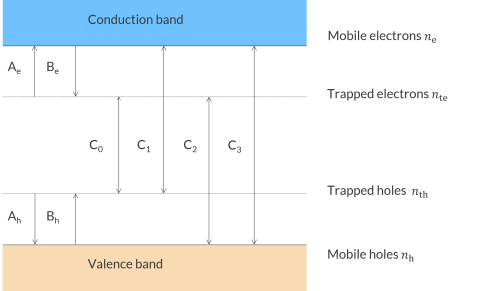
Ae and Ah are detrapping rate for trapped electrons and trapped holes (SI unit: 1/s)
Be and Bh are trapping rate for electrons and holes (SI unit: 1/s)
νte and νth are attempt-to-escape frequency for trapped electrons and trapped holes (SI unit: 1/s)
φte and φth are detrapping barrier height for trapped electrons and trapped holes (SI unit: V)
n0,te and n0,th are density of deep traps for electrons and holes (SI unit: 1/m3)
kB is the Boltzmann constant (SI unit: J/K)
T is the temperature (SI unit: K)
C0 is the trapped electron–trapped hole recombination coefficient (SI unit: m3/s)
C1 is the electron–trapped hole recombination coefficient (SI unit: m3/s)
C2 is the trapped electron–hole recombination coefficient (SI unit: m3/s)
C3 is the electron–hole recombination coefficient (SI unit: m3/s)
The above transport equations are fully coupled with Poisson’s equation through the electric field and the space charge:
The above bipolar charge transport equations are based on a two-level transition model, as shown in Figure 3-3.
Figure 3-3: Conduction and trapping model for solid dielectrics.