The Value of the Bulk Viscosity
The value of the bulk viscosity is difficult to measure and typically requires absorption experiments to be determined. For most fluids, its numerical value is of the same order as the dynamic viscosity. For some further details see, for example, Ref. 14 for fluids, Ref. 16 for water values, and Ref. 15 for gases.
The bulk viscosity enters the classical (pure) thermoviscous attenuation coefficient defined as
This is the attenuation experienced by plane propagating waves away from boundaries. The expression is derived directly from the full thermoviscous acoustics equations. In the Air and Water, liquid materials in the Material Library, the bulk viscosity is defined to match the high-frequency absorption properties of the fluids.
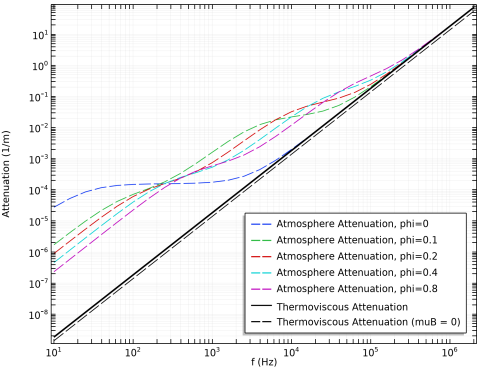
In Figure 14-1 standardized atmosphere attenuation curves (see the Atmosphere Attenuation Fluid Model in pressure acoustics) are depicted for various relative humidities together with the classical thermoviscous attention. The graph also shows the case for zero bulk viscosity. The bulk viscosity is defined such that the thermoviscous absorption curve matches the standard at high frequencies, this happens for μB = 0.6·μ. This corresponds to how the value is determined in an experimental setup.
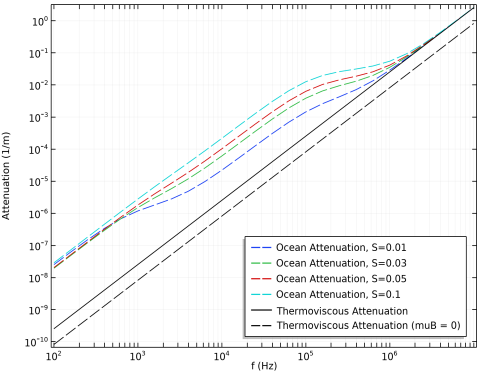
The same graphs are depicted in Figure 14-2 for water using the Ocean Attenuation Fluid Model, here for various values of the practical salinity (with a pH value of 7 and evaluated at the sea surface). The attenuation match gives a value for the bulk viscosity of μB = 2.79·μ. This is also the value reported in the literature (see Ref. 14 and 16).

Figure 14-1: Atmosphere attenuation for various relative humidities (phi), the full classical thermoviscous attenuation, and thermoviscous attenuation for zero bulk viscosity.
Figure 14-2: Ocean attenuation for various practical salinities (S·1000), the full classical thermoviscous attenuation, and thermoviscous attenuation for zero bulk viscosity.