
Quadrupole Point Source
Use the Quadrupole Point Source node to enter a quadrupole point source. A quadrupole is mathematically a source that corresponds to two dipoles close to each other. A complex acoustic source may be expanded and approximated by a collection of point sources (Monopole Point Source, Dipole Point Source, and Quadrupole Point Source). Add this node from the Points submenu.
The quadrupole point source adds a point source term to the right-hand side of the governing Helmholtz equation such that:
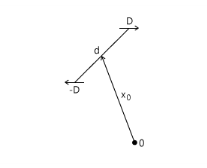
where δ(x − x0) is the delta function in three dimensions and adds the source at the point where x = x0. The quadrupole D-vector D (SI unit: N) and the quadrupole d-vector d (SI unit: m) depend on the source type selected, as discussed below. In 2D axisymmetric models, the quadrupole point source is only added to the z-axis, such that x0 = (0,0,z) and only orientations along the axis are possible (valid for 0 azimuthal mode number m). Two types of predefined quadrupole sources exist, a Power (longitudinal) and a Power (lateral) configuration. In the longitudinal source, the D and d vectors are parallel and point in the same direction. In the lateral configuration, the D and d vectors are perpendicular to each other (see Ref. 5 for details).
Quadrupole Point Source
Select a Type: Power (longitudinal) (the default), Power (lateral), or User defined. The lateral options do not exist in 2D-axisymmetric models.
User Defined
For User defined enter the Quadrupole d vector (SI unit: m) and Quadrupole D vector (SI unit: N). In 2D axisymmetric models enter a Quadrupole amplitude Q (SI unit: N⋅m) as both the D and d vectors are pointed along the z-axis.
Figure 2-5: Schematic illustration of the user-defined quadrupole point source.
Power (Longitudinal)
The Power (longitudinal) defines the following values for the two quadrupole vectors
Enter the following:
•
Free space reference power (RMS), Prms (SI unit: W). In a homogeneous medium, the specified power is radiated (the reference), but with other objects and boundaries present the actual power is different.
•
The source Phase ϕ (SI unit: rad).
•
Quadrupole direction, e'D (dimensionless). In a 2D axisymmetric model, the direction is along the z-axis.
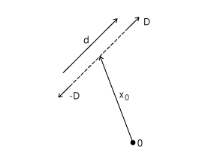
Figure 2-6: Schematic illustration of the longitudinal power quadrupole point source.
Power (Lateral)
The Power (lateral), not defined in 2D axisymmetric components, defines the following values for the two quadrupole vectors:
Enter the following:
•
Free space reference power (RMS), Prms (SI unit: W). In a homogeneous medium, the specified power is radiated (the reference), but with other objects and boundaries present the actual power is different.
•
The source Phase ϕ (SI unit: rad).
•
Quadrupole normal, n (dimensionless). This is the normal to the plane in which the quadrupole is located.
•
Quadrupole direction, e'D (dimensionless). The projection of this vector onto the plane (defined by the normal n) defines the direction of the dipole D-vector.
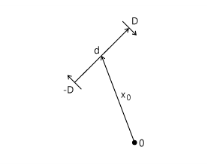
Figure 2-7: Schematic illustration of lateral quadrupole point source.