You are viewing the documentation for an older COMSOL version. The latest version is available here.
Tutorial Model: Molecular Flow in an Ion Implant Vacuum System
This example considers the design of an ion implantation system. Ion implantation is used extensively in the semiconductor industry to implant dopants into wafers. Within an ion implanter, ions generated within an ion source are accelerated by an electric field to achieve the desired implant energy. Ions of the correct charge state are selected by means of a separation magnet, which bends the ion beam to ensure that ions of a particular charge-to-mass ratio are the only ones reaching the wafer. The energy dose and angle of the ion beam are both key parameters for the process. This part of the system is known as the corrector.
Usually, it is desired that only selected regions of the wafer are implanted. This is achieved by masking parts of the wafer with an organic photoresist, to produce the desired pattern. Unfortunately, the photoresist itself emits gas molecules as a result of the beam striking it. These molecules can interact with the ion beam and produce species with undesired charge-to-mass ratios at different points along the beam path. Some of these species may reach the wafer, degrading the uniformity of the implant, which is highly undesirable. Additionally, these ions may also affect the measurement accuracy of the implant dose. A key requirement for the system is that the number density of the outgassing molecules for the wafer is low along the beam line.
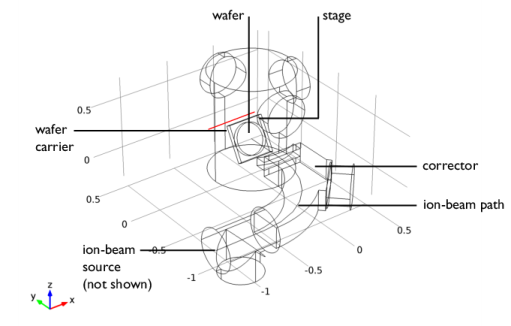
Figure 7: Model geometry. Key components of the system are labeled. The red line running through the center of the wafer carrier indicates the axis of rotation of the carrier.
This example shows how to model an ion implantation system using the Free Molecular Flow interface. The model geometry is shown in Figure 7. The wafer is positioned on a carrier plate that is rotated about an axis through its center to achieve different implant angles. The carrier plate is mounted in a chamber that is pumped by three large cryopumps, located on cylindrical vacuum ports. These pumps have a pump speed of 12,000 l/s. In this model, outgassing of only one species from the wafer (H2) is considered: multiple species can be added in the Dependent Variables section the Free Molecular Flow settings window. It is assumed that the outgassing across the wafer surface is uniform and that the total gas emitted is 30 sccm. The vacuum path through the corrector magnetic field enters the main chamber opposite the wafer. The corrector is pumped by a turbomolecular pump on a cylindrical port halfway along the beam path (pump speed: 1500 l/s), and an additional cryopump at the start of the beam path (pump speed: 12,000 l/s). There is an aperture at the entrance to the chamber that reduces the flux entering the corrector. The angle between the wafer outward normal and the ion beam is swept from 0° to 60° in 20° steps, as the wafer is rotated about the horizontal axis through its center, as shown in Figure 7. All other surfaces in the model are walls. Since the interaction of the outgassing molecules with the beam produces undesirable species, the average number density of the molecules along the beam path is used as a figure of merit to evaluate the effect of rotating the wafer.
Note: This model is motivated by the paper: M.R. LaFontaine, N. Tokoro, P. Murphy, and D. Holbrook, “Modeling Photoresist Outgassing Pressure Distribution Using the Finite Element Method,” Proc. Conference on Ion Implantation Technology, IEEE Press, pp. 247–250, 2000. COMSOL’s Molecular Flow interface is, however, a significant improvement on the ‘radiation method’ used in this paper because the pressure and number density are computed correctly by separate integrals.