

You are viewing the documentation for an older COMSOL version. The latest version is available here.
PDF

Primary Creep Under Nonconstant Load
Introduction
In this model example, you study the creep behavior of material under nonconstant loading. You model the primary creep using a Norton-Bailey law and study the difference between the time hardening and the strain hardening methods available in COMSOL Multiphysics.
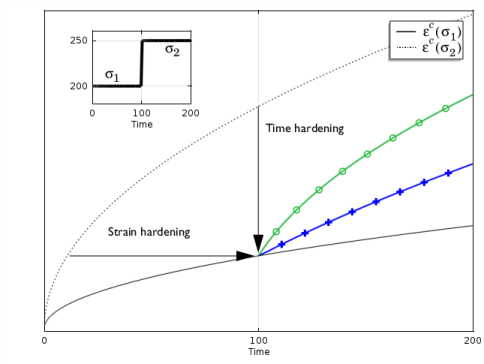
Time hardening assumes that the creep strain rate depends on the current stress and on the time passed from the start of the test. Strain hardening assumes that the creep strain rate depends on the current stress and the accumulated creep strain. Therefore, once the stress level changes, in time hardening the material follows the new behavior from the point where the times are equal, the strain-time relation shifts vertically. In strain hardening, the material follows the new behavior form the point where the strains are equal, the strain-time behavior shifts horizontally. This is illustrated in Figure 1 below.
Figure 1: Strain versus time curve for different primary creep formulations: time hardening in blue(+) and strain hardening in green (o). The load case is represented in the thumbnail in the upper-left corner.
The time hardening formulation is easier to use, while the strain hardening is usually considered to be more accurate.
The model is taken from NAFEMS Understanding Non-Linear Finite Analysis Through Illustrative Benchmarks (Ref. 1). The load consist of a uniaxial and a biaxial stepped load. The step in the load occurs at after a half of the full study time. The value of interest is the creep strain variation along the time. The computed solutions are compared with analytical solution given in the reference.
Additionally, a short discussion describes how to avoid nonphysical creep strains that can appear at the initial time step when a singular load condition is applied at early time.
Model Definition
The problem consists of a 100 mm length square plate under uniaxial and biaxial load cases. Different boundary constraints for each load case ensure uniaxial stress. After 100 hours, the applied load jump from 200 MPa to 250 MPa.
The thickness of the plate is assumed to be small enough to use the 2D plane stress assumption.
The Norton-Bailey that model the creep behavior is represented with the following creep strain definition:
The material constants are listed in the table below:
Both the time hardening and the strain hardening are used to represent the step load response versus time.
Results and Discussion
The problem has analytical results for both uniaxial and biaxial load cases, and for both the time and strain hardening formulations.
For the uniaxial load case, the target solution for the x-component of the creep strain is represented by the following expression:
The target solution for the biaxial load case is represented by the following expression:
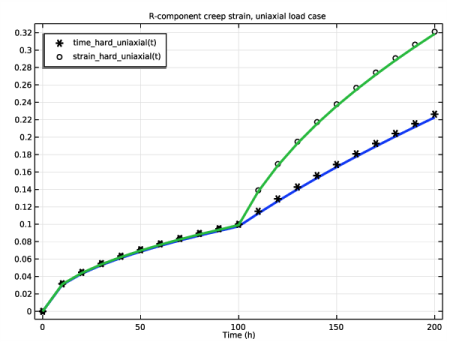
In Figure 2, you can see the results of the computed x-component of the creep strain for the uniaxial load case together with the target data (represented with markers).
Figure 2: The creep strain for time hardening (blue line) and strain hardening (green line) for the uniaxial load case. The reference data is represented by markers.
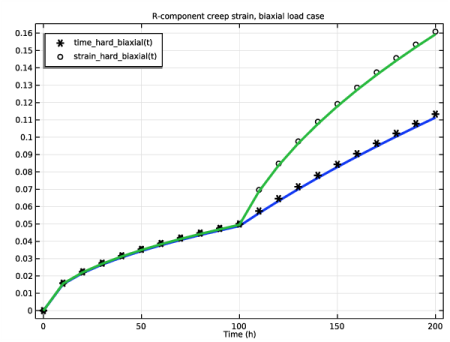
In the Figure 3, you can see the results of the computed x-component of the creep strain for the biaxial load case together with the target data (represented with markers).
Figure 3: The creep strain for time hardening (blue line) and strain hardening (green line) for the biaxial load case. The reference data is represented by markers.
The computed solutions agree very well with the analytical target for both the uniaxial and the biaxial load cases.
Notes About the COMSOL Implementation
A constant load at the initial time introduces a stress singularity. This can be a source of errors when the strain is defined via a strain rate formulation. At an infinitesimal time step, a nonphysical strain rate can be generated. You can avoid such a singularity by defining the load case using a smooth increase in time. Another solution is to enforce the initial computational time step to be large enough so that the creep strain is reduced. In COMSOL Multiphysics, the time hardening implementation makes it possible to define a time offset. Adjusting the time offset with the initial computational time step ensures to reduce the initial creep strain error. The time should be small compared to the computational study time. In the current example, a time of 1 second as been found sufficient.
For the strain hardening implementation, an initial strain value is requested to avoid an error related to computation a non-integer power of a negative number. Here, a value of 1×10⁻⁵ is found to be sufficient.
In this model, the Test material feature is used to automate the setup of uniaxial and biaxial tests for the two different creep models.
Reference
1. A.A. Becker, Understanding Non-Linear Finite Element Analysis Through Illustrative Benchmarks, NAFEMS R0080, 2001.
Application Library path: Nonlinear_Structural_Materials_Module/Creep/variable_load_creep
Modeling Instructions
From the File menu, choose New.
New
In the New window, click  Model Wizard.
Model Wizard
1
In the Model Wizard window, click  2D.
2
In the Select Physics tree, select Structural Mechanics>Solid Mechanics (solid).
3
Click Add.
4
Root
1
In the Model Builder window, click the root node.
2
In the root node’s Settings window, locate the Unit System section.
3
From the Unit system list, choose MPa.
Global Definitions
Parameters 1
1
In the Model Builder window, under Global Definitions click Parameters 1.
2
In the Settings window for Parameters, locate the Parameters section.
3
Step 1 (step1)
1
In the Home toolbar, click  Functions and choose Global>Step.
2
In the Settings window for Step, type load in the Function name text field.
3
Locate the Parameters section. In the Location text field, type 100.
4
In the From text field, type 200.
5
In the To text field, type 250.
Piecewise 1 (pw1)
1
In the Home toolbar, click  Functions and choose Global>Piecewise.
2
In the Settings window for Piecewise, type time_hard_uniaxial in the Function name text field.
3
Locate the Definition section. In the Argument text field, type t.
4
Find the Intervals subsection. In the table, enter the following settings:
5
Locate the Units section. In the Arguments text field, type h.
6
In the Function text field, type 1.
Piecewise 2 (pw2)
1
In the Home toolbar, click  Functions and choose Global>Piecewise.
2
In the Settings window for Piecewise, type strain_hard_uniaxial in the Function name text field.
3
Locate the Definition section. In the Argument text field, type t.
4
Find the Intervals subsection. In the table, enter the following settings:
5
Locate the Units section. In the Arguments text field, type h.
6
In the Function text field, type 1.
Piecewise 3 (pw3)
1
In the Home toolbar, click  Functions and choose Global>Piecewise.
2
In the Settings window for Piecewise, type time_hard_biaxial in the Function name text field.
3
Locate the Definition section. In the Argument text field, type t.
4
Find the Intervals subsection. In the table, enter the following settings:
5
Locate the Units section. In the Arguments text field, type h.
6
In the Function text field, type 1.
Piecewise 4 (pw4)
1
In the Home toolbar, click  Functions and choose Global>Piecewise.
2
In the Settings window for Piecewise, type strain_hard_biaxial in the Function name text field.
3
Locate the Definition section. In the Argument text field, type t.
4
Find the Intervals subsection. In the table, enter the following settings:
5
Locate the Units section. In the Arguments text field, type h.
6
In the Function text field, type 1.
Geometry 1
Square 1 (sq1)
1
In the Geometry toolbar, click  Square.
2
In the Settings window for Square, locate the Size section.
3
In the Side length text field, type 100[mm].
4
Click  Build Selected.
Array 1 (arr1)
1
In the Geometry toolbar, click  Transforms and choose Array.
2
3
In the Settings window for Array, locate the Size section.
4
In the x size text field, type 2.
5
Locate the Displacement section. In the x text field, type 200[mm].
6
Click  Build Selected.
7
Click the  Zoom Extents button in the Graphics toolbar.
Solid Mechanics (solid)
1
In the Model Builder window, under Component 1 (comp1) click Solid Mechanics (solid).
2
In the Settings window for Solid Mechanics, locate the 2D Approximation section.
3
4
Locate the Structural Transient Behavior section. From the list, choose Quasistatic.
Linear Elastic Material 1
In the Model Builder window, under Component 1 (comp1)>Solid Mechanics (solid) click Linear Elastic Material 1.
Creep 1
1
In the Physics toolbar, click  Attributes and choose Creep.
2
In the Settings window for Creep, locate the Creep Model section.
3
Find the Isotropic hardening model subsection. From the h  (εce  ,t) list, choose Time hardening.
4
In the m text field, type m.
5
In the tshift text field, type t0.
Linear Elastic Material [with Time Hardening Creep]
1
In the Model Builder window, under Component 1 (comp1)>Solid Mechanics (solid) click Linear Elastic Material 1.
2
In the Settings window for Linear Elastic Material, type Linear Elastic Material [with Time Hardening Creep] in the Label text field.
Linear Elastic Material [with Strain Hardening Creep]
1
Right-click Linear Elastic Material [with Time Hardening Creep] and choose Duplicate.
2
In the Settings window for Linear Elastic Material, type Linear Elastic Material [with Strain Hardening Creep] in the Label text field.
3
Locate the Domain Selection section. Click  Clear Selection.
4
Creep 1
1
In the Model Builder window, expand the Linear Elastic Material [with Strain Hardening Creep] node, then click Creep 1.
2
In the Settings window for Creep, locate the Creep Model section.
3
Find the Isotropic hardening model subsection. From the h  (εce  ,t) list, choose Strain hardening.
4
In the m text field, type m.
Materials
Material 1 (mat1)
1
In the Model Builder window, under Component 1 (comp1) right-click Materials and choose Blank Material.
2
In the Settings window for Material, locate the Material Contents section.
3
Use the Test Material feature to carry out uniaxial and biaxial tests with time hardening and strain hardening creep.
Solid Mechanics (solid)
Test Material [Time Hardening Creep]
1
In the Physics toolbar, click  Global and choose Test Material.
2
In the Settings window for Test Material, type Test Material [Time Hardening Creep] in the Label text field.
3
4
Locate the Material Tests section. From the Study setup list, choose Time dependent.
5
In the Np text field, type 20.
6
In the tf text field, type 200[h].
7
From the Test setup list, choose User defined.
8
From the Test control list, choose Force driven.
9
Find the Tests subsection. In the f text field, type load(t[1/h]).
10
Select the Biaxial test check box.
11
In the f text field, type load(t[1/h]).
12
Click Auto Test Setup in the upper-right corner of the Material Tests section. From the menu, choose Setup Tests.
Test Material [Strain Hardening Creep]
1
In the Model Builder window, right-click Test Material [Time Hardening Creep] and choose Duplicate.
2
In the Settings window for Test Material, type Test Material [Strain Hardening Creep] in the Label text field.
3
Locate the Domain Selection section. Click  Clear Selection.
4
5
Click Auto Test Setup in the upper-right corner of the Material Tests section. From the menu, choose Setup Tests.
Results
Creep Strain, Uniaxial
1
In the Model Builder window, expand the Results node.
2
Right-click Results and choose 1D Plot Group.
3
In the Settings window for 1D Plot Group, type Creep Strain, Uniaxial in the Label text field.
4
Click to expand the Title section. From the Title type list, choose Manual.
5
In the Title text area, type R-component creep strain, uniaxial load case.
6
Locate the Legend section. From the Position list, choose Upper left.
Point Graph 1
1
Right-click Creep Strain, Uniaxial and choose Point Graph.
2
In the Settings window for Point Graph, locate the Data section.
3
From the Dataset list, choose Study: Test Material [Time Hardening Creep]/Solution 1 (4) (solidtm1sol1).
4
From the Parameter selection (testPara_solidtm1) list, choose First.
5
6
Click Replace Expression in the upper-right corner of the y-Axis Data section. From the menu, choose Component: Test Material [Time Hardening Creep] (solidtm1comp)>Solid Mechanics>Strain (Gauss points)>Creep strain tensor, local coordinate system>solid1.eclGp11 - Creep strain tensor, local coordinate system, 11-component.
7
Locate the x-Axis Data section. From the Unit list, choose h.
8
Click to expand the Coloring and Style section. From the Width list, choose 3.
Global 1
1
In the Model Builder window, right-click Creep Strain, Uniaxial and choose Global.
2
In the Settings window for Global, locate the y-Axis Data section.
3
4
Locate the x-Axis Data section. From the Unit list, choose h.
5
Click to expand the Coloring and Style section. Find the Line style subsection. From the Line list, choose None.
6
From the Color list, choose From theme.
7
Find the Line markers subsection. From the Marker list, choose Cycle.
8
Click to expand the Legends section. Find the Include subsection. Select the Expression check box.
Point Graph 2
1
In the Model Builder window, under Results>Creep Strain, Uniaxial right-click Point Graph 1 and choose Duplicate.
2
In the Settings window for Point Graph, locate the Data section.
3
From the Dataset list, choose Study: Test Material [Strain Hardening Creep]/Solution 1a (10) (solidtm2sol1).
4
Locate the Selection section. Click to select the  Activate Selection toggle button.
5
6
Click Replace Expression in the upper-right corner of the y-Axis Data section. From the menu, choose Component: Test Material [Strain Hardening Creep] (solidtm2comp)>Solid Mechanics>Strain (Gauss points)>Creep strain tensor, local coordinate system>solid2.eclGp11 - Creep strain tensor, local coordinate system, 11-component.
Global 1
1
In the Model Builder window, click Global 1.
2
In the Creep Strain, Uniaxial toolbar, click  Plot.
3
In the Settings window for Global, locate the y-Axis Data section.
4
5
In the Creep Strain, Uniaxial toolbar, click  Plot.
Creep Strain, Biaxial
1
In the Home toolbar, click  Add Plot Group and choose 1D Plot Group.
2
In the Settings window for 1D Plot Group, type Creep Strain, Biaxial in the Label text field.
3
Locate the Title section. From the Title type list, choose Manual.
4
In the Title text area, type R-component creep strain, biaxial load case.
5
Locate the Legend section. From the Position list, choose Upper left.
Point Graph 1
1
Right-click Creep Strain, Biaxial and choose Point Graph.
2
In the Settings window for Point Graph, locate the Data section.
3
From the Dataset list, choose Study: Test Material [Time Hardening Creep]/Solution 1 (4) (solidtm1sol1).
4
From the Parameter selection (testPara_solidtm1) list, choose Last.
5
6
Click Replace Expression in the upper-right corner of the y-Axis Data section. From the menu, choose Component: Test Material [Time Hardening Creep] (solidtm1comp)>Solid Mechanics>Strain (Gauss points)>Creep strain tensor, local coordinate system>solid1.eclGp11 - Creep strain tensor, local coordinate system, 11-component.
7
Locate the x-Axis Data section. From the Unit list, choose h.
8
Locate the Coloring and Style section. From the Width list, choose 3.
Global 1
1
In the Model Builder window, right-click Creep Strain, Biaxial and choose Global.
2
In the Settings window for Global, locate the y-Axis Data section.
3
4
Locate the x-Axis Data section. From the Unit list, choose h.
5
Locate the Coloring and Style section. Find the Line style subsection. From the Line list, choose None.
6
From the Color list, choose From theme.
7
Find the Line markers subsection. From the Marker list, choose Cycle.
8
Locate the Legends section. Find the Include subsection. Select the Expression check box.
Point Graph 2
1
In the Model Builder window, under Results>Creep Strain, Biaxial right-click Point Graph 1 and choose Duplicate.
2
In the Settings window for Point Graph, locate the Data section.
3
From the Dataset list, choose Study: Test Material [Strain Hardening Creep]/Solution 1a (10) (solidtm2sol1).
4
Locate the Selection section. Click to select the  Activate Selection toggle button.
5
6
Click Replace Expression in the upper-right corner of the y-Axis Data section. From the menu, choose Component: Test Material [Strain Hardening Creep] (solidtm2comp)>Solid Mechanics>Strain (Gauss points)>Creep strain tensor, local coordinate system>solid2.eclGp11 - Creep strain tensor, local coordinate system, 11-component.
Global 1
1
In the Model Builder window, click Global 1.
2
In the Creep Strain, Biaxial toolbar, click  Plot.
3
In the Settings window for Global, locate the y-Axis Data section.
4
5
In the Creep Strain, Biaxial toolbar, click  Plot.