You are viewing the documentation for an older COMSOL version. The latest version is
available here
.
The Physics Interfaces
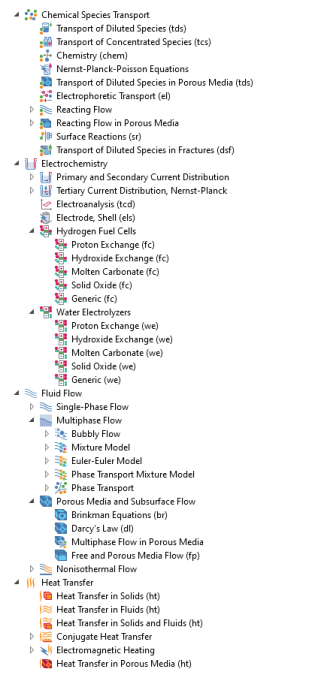
Figure 3
below shows the Fuel Cell & Electrolyzer Module interfaces and other physics interfaces available in COMSOL Multiphysics but with functionality extended by the module, for example the Chemical Species Transport branch interfaces.
Figure 3:
The 3D physics interfaces for the Fuel Cell & Electrolyzer Module as shown in the Model Wizard.
The Electrochemistry (
) interfaces are based on the conservation of current, charge, chemical species, and energy. The Hydrogen Fuel Cell (
) interfaces and Water Electrolyzer (
) interfaces are tailor made interfaces for these cell types. These interfaces combine electrolyte and electrode charge transport with charge transfer reactions, and, optionally, gas phase mass transport and momentum transport by Darcy’s law. Alternatively, the fluid flow in the gas channels and in the GDEs can be modeled by any of the Fluid Flow interfaces — such as Laminar Flow (
), Free or Porous Media Flow (
) and coupled to the hydrogen fuel cell or water eletrolyzer interface.
For other types of fuel cells and electrolyzers (for instance a chlorine electrolyzer), the current transport by ions in the bulk electrolyte and in the pore electrolyte, the current transport by electrons, and the charge transfer reactions may be defined by the generic Primary Current Distribution (
), Secondary Current Distribution (
), and the Tertiary Current Distribution, Nernst–Planck (
) interfaces. The Primary Current Distribution interface neglects the variations in composition in the electrolyte and the activation losses for the charge transfer reactions. It should typically be used for electrolytes with fixed charge carriers or well mixed electrolytes, and in the cases where the activation losses are substantially smaller than the conductivity losses. In the Secondary Current Distribution interface, the variations in composition in the electrolyte are also neglected, while the activation losses for the charge transfer reactions are taken into account. In the Tertiary Current Distribution, Nernst-Planck interface, also the contribution of diffusion to the transport of ions, and thus the bulk electrolyte contribution to the current in the electrolyte, is taken into account.
When modeling charge transport with a generic current distribution interface, the transport of gaseous species and other mass transport phenomena can be modeled using any of the Chemical Species Transport interfaces (
), which all have nodes that couple the transport in the gas phase to the electrochemical reactions. The Chemical Species Transport interfaces are also coupled to the Fluid Flow interfaces (
) through the gas density, which is influenced by the gas composition. A convenient way of coupling chemical species transport to fluid flow is by using one of the Reacting Flow interfaces (Reacting Flow (
) or Reacting Flow in Porous Media (
)), which contain predefined multiphysics couplings.
The Heat Transfer interfaces (
) handle the effects of Joule heating in the bulk electrolyte, in the pore electrolyte, and in the electrodes. They include the contribution to the thermal balance from the electrochemical reactions due to the activation overpotential and the net change of entropy.
The Electrode, Shell interface (
) models electric current conduction in the tangential direction on a boundary. The physics interface is suitable to use for thin electrodes where the potential variation in the normal direction to the electrode is negligible. This assumption allows for the thin electrode domain to be replaced by a partial differential equation on the boundary. In this way the problem size can be reduced, and potential problems with mesh anisotropy in the thin layer can be avoided.
 ) interfaces are based on the conservation of current, charge, chemical species, and energy. The Hydrogen Fuel Cell (
 ) interfaces and Water Electrolyzer (
 ) interfaces are tailor made interfaces for these cell types. These interfaces combine electrolyte and electrode charge transport with charge transfer reactions, and, optionally, gas phase mass transport and momentum transport by Darcy’s law. Alternatively, the fluid flow in the gas channels and in the GDEs can be modeled by any of the Fluid Flow interfaces — such as Laminar Flow (
 ), Free or Porous Media Flow (
 ) and coupled to the hydrogen fuel cell or water eletrolyzer interface.
 ), Secondary Current Distribution (
 ), and the Tertiary Current Distribution, Nernst–Planck (
 ) interfaces. The Primary Current Distribution interface neglects the variations in composition in the electrolyte and the activation losses for the charge transfer reactions. It should typically be used for electrolytes with fixed charge carriers or well mixed electrolytes, and in the cases where the activation losses are substantially smaller than the conductivity losses. In the Secondary Current Distribution interface, the variations in composition in the electrolyte are also neglected, while the activation losses for the charge transfer reactions are taken into account. In the Tertiary Current Distribution, Nernst-Planck interface, also the contribution of diffusion to the transport of ions, and thus the bulk electrolyte contribution to the current in the electrolyte, is taken into account.
 ), which all have nodes that couple the transport in the gas phase to the electrochemical reactions. The Chemical Species Transport interfaces are also coupled to the Fluid Flow interfaces (
 ) through the gas density, which is influenced by the gas composition. A convenient way of coupling chemical species transport to fluid flow is by using one of the Reacting Flow interfaces (Reacting Flow (
 ) or Reacting Flow in Porous Media (
 )), which contain predefined multiphysics couplings.
 ) handle the effects of Joule heating in the bulk electrolyte, in the pore electrolyte, and in the electrodes. They include the contribution to the thermal balance from the electrochemical reactions due to the activation overpotential and the net change of entropy.
 ) models electric current conduction in the tangential direction on a boundary. The physics interface is suitable to use for thin electrodes where the potential variation in the normal direction to the electrode is negligible. This assumption allows for the thin electrode domain to be replaced by a partial differential equation on the boundary. In this way the problem size can be reduced, and potential problems with mesh anisotropy in the thin layer can be avoided.