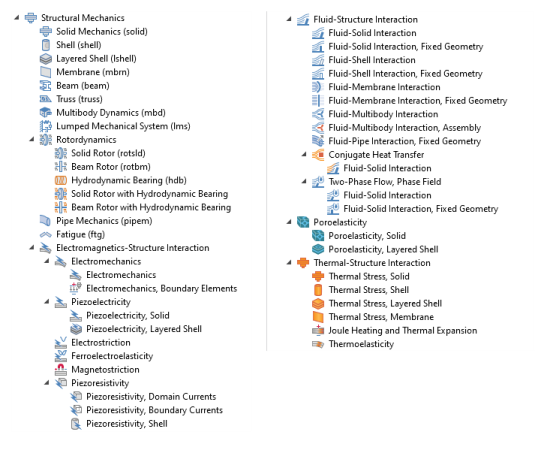
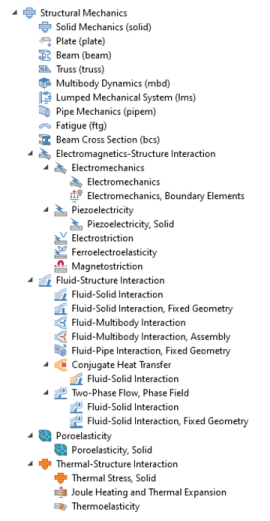
 ) defines the quantities and features for stress analysis and general linear and nonlinear solid mechanics. In 2D, plane stress, plane strain, and generalized plane strain formulations are available. The Linear Elastic Material node is the default material model. The elastic material model can be expanded with features for thermal expansion, hygroscopic swelling, viscoelasticity, damping, and initial stress and strain. The description of elastic materials in the module includes isotropic, orthotropic, and fully anisotropic materials. The material can be activated or deactivated based on for example time or temperature. A number of preset study types are available for solid mechanics (shown below). Also, see Physics Interface Guide by Space Dimension and Study Type.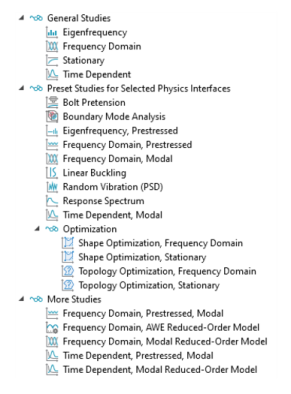
 Acoustics Acoustics |
|||||
 Elastic Waves Elastic Waves |
|||||
 |
|||||
 Fluid Flow Fluid Flow |
|||||
 Fluid-Structure Interaction Fluid-Structure Interaction |
|||||
 |
|||||
 |
|||||
 |
|||||
 |
|||||
 |
|||||
 |
|||||
 |
|||||
 |
|||||
 |
|||||
 |
|||||
 Structural Mechanics Structural Mechanics |
|||||
 |
stationary; eigenfrequency; eigenfrequency, prestressed; mode analysis; time dependent; time dependent, modal; time dependent, prestressed, modal; time dependent, modal reduced-order model; frequency domain; frequency domain, modal; frequency domain, prestressed; frequency domain, prestressed, modal; frequency domain, modal reduced-order model; frequency domain, AWE reduced-order model; response spectrum; random vibration (PSD); linear buckling; bolt pretension
|
||||
 |
|||||
 |
|||||
 |
|||||
 |
|||||
 |
|||||
 |
|||||
 |
|||||
 |
|||||
 |
|||||
 |
|||||
 |
|||||
 |
|||||
 |
|||||
 |
|||||
 |
|||||
 |
|||||
|
1 This physics interface is included with the core COMSOL package but has added functionality for this module.
|
|||||
|
2 This physics interface is a predefined multiphysics coupling that automatically adds all the physics interfaces and coupling features required.
|
|||||
|
3 Requires the addition of the AC/DC Module.
|
|||||
|
4 Requires the addition of the Heat Transfer Module
|
|||||
|
5 Requires the addition of the Composite Materials Module
|
|||||
|
6 Requires the addition of the CFD Module or the Microfluidics Module
|
|||||
|
7 Requires the addition of the Pipe Flow Module
|
|||||
|
8 Requires the addition of the Porous Media Flow Module
|
|||||
|
9 Requires the addition of the AC/DC Module or the MEMS Module
|
|||||
 ) is intended for the structural analysis of thin-walled structures. The formulation used in the Shell interface is a Mindlin-Reissner type, which means that transverse shear deformations are accounted for. It can be used for rather thick shells as well as thin ones. It is possible to prescribe an offset in a direction normal to a selected surface, which for example can be used when meshing imported geometries. The Shell interface also includes other features such as damping, thermal expansion, and initial stresses and strains. With the Composite Materials Module, it is also possible to analyze layered shells. Through the addition of the Nonlinear Structural Materials Module, it is possible to model material behavior like plasticity, hyperelasticity, creep, and viscoplasticity.
 ) is a 2D analogy to the 3D Shell interface. Plates are similar to shells, but act in a single plane and usually act only with out-of-plane loads. The formulation and features for this physics interface are similar to those for the Shell interface.
 ) is used for thin membranes, which can be considered as curved plane stress elements in 3D having in-plane as well as out-of-plane deformation. The difference between a shell and a membrane is that a membrane does not possess any bending stiffness. Thin films and fabric are structures suited for modeling with the Membrane interface. With the Nonlinear Structural Materials Module, hyperelasticity, nonlinear elasticity, plasticity, creep, and viscoplasticity can be modeled in addition to the default linear elastic material. With the Composite Materials Module, it is also possible to analyze layered membranes.
 ) is intended for the modeling of slender structures (beams) that can be fully described by their cross-section properties, such as area and moment of inertia. The Beam interface defines stresses and strains using Hermitian elements and Euler-Bernoulli or Timoshenko theory. Beam elements are used to model both planar and three-dimensional frame structures. This physics interface is also suitable for modeling reinforcements of solid and shell structures. It includes a library for rectangular, box, circular, pipe, hat, H-profile, U-profile, C-profile, and T-profile beam sections. Additional features include damping, thermal expansion, and initial stresses and strains.
 ) can be used to compute the properties of general cross sections, to be used as inputs in beam analysis. The interface can also be used for detailed stress evaluation in beams, given the forces and moments acting on the section.
 ) can be used to model slender structures that can only sustain axial forces. Trusses are modeled using Lagrange shape functions, which allow the specification of small strains as well as Green-Lagrange strains for large deformations. In addition to classical truss structures, the interface can be used for modeling cables exposed to gravity forces (sagging cables). Additional features include damping, thermal expansion, and initial stresses and strains. The default material model is linear elastic, and together with the Nonlinear Structural Materials Module, it is possible to also model plasticity and shape memory alloys.
 ) interface is intended for stress and deformation analysis in pipe systems, either standalone, or together with the Pipe Flow interface. Pipes are similar to beams, but stresses from internal pressure and temperature gradients through the pipe wall are part of the formulation.
 ) combines the Solid Mechanics interface with the Heat Transfer in Solids interface. The temperature field is automatically coupled to a structure’s thermal expansion, and also to any temperature dependent material properties. Similar interfaces are available also for shells and membranes.
 ) combines three physics interfaces: Joule Heating, Heat Transfer in Solids, and Solid Mechanics. It describes the conduction of electric current in a structure, the subsequent electric heating caused by the ohmic losses, and the thermal stresses induced by the temperature field.
 ) combines the Solid Mechanics and Electrostatics interfaces to model piezoelectric materials. The piezoelectric coupling can be in stress-charge or strain-charge form. All solid mechanics and electrostatics functionalities are also accessible through this physics interface, for example, for modeling the surrounding linear elastic solids or air domains. For the Layered Shell interface, the Piezoelectricity, Layered Shell interface (
 ) offers similar capabilities.
 ) combines the Solid Mechanics and Magnetic Fields interfaces to model magnetostrictive materials. Linear as well as nonlinear materials models are available. This interface requires the AC/DC module.
 ) interface combines Solid Mechanics and Electrostatics together with the constitutive relationships required to model nonlinear ferroelectric materials with polarization saturation and possible hysteresis. Many piezoelectric materials exhibit such nonlinear ferroelectroelastic behavior at large applied electric fields. This interface requires the AC/DC module or the MEMS module.
 ), a Solid Mechanics interface and a Single Phase Flow interface model the solid and the fluid, respectively. Together with CFD Module, also turbulent flow and two-phase flow can be studied. The FSI couplings appear on the boundaries between the fluid and the solid. The Fluid-Structure Interaction interface uses an arbitrary Lagrangian-Eulerian (ALE) method; it combines the fluid flow formulated by an Eulerian description and a spatial frame with solid mechanics formulated by a Lagrangian description and a material (reference) frame.
 ) interface can be used to model phenomena where a fluid and a deformable solid structure affect each other. Both the fluid loading on the structure and the structural velocity transmission to the fluid can be taken into account. The interface models situations where the displacements of the solid are assumed to be small enough for the geometry of the fluid domain to be considered as fixed during the simulation.